“FSU’s collaborative research environment provides a platform to combine data-driven modeling, environmental chemistry and sustainability science to address critical global water contamination issues.”
- Favorite Sport: Tennis
- Favorite Hobby: Traveling to appreciate new places and cultures
- Favorite Music Genres: Bengali, Hindi, Spanish or English songs
- Dream Community Impact: Creating a nonprofit focused on clean water access
- Dissertation Topic: Machine learning, deep learning and watershed modeling
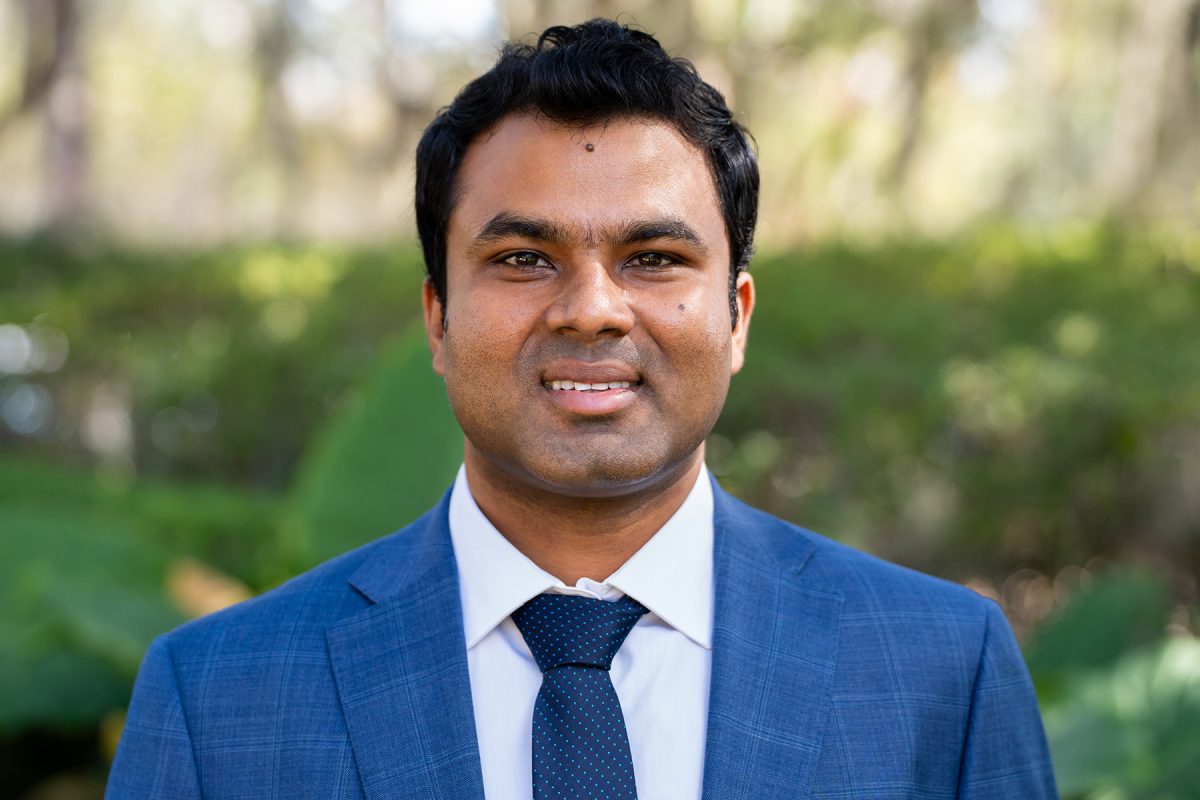
Shahin Alam, a doctoral student at Florida State University, demonstrates his dedication to civil engineering through his dissertation on hydraulic elements within the St. Johns River Basin.
During his time at FSU, Alam has actively participated in leadership and service projects that enhance academic achievement, professional growth and increased student involvement.
With the mentorship of civil and environmental engineering professor Gang Chen, Alam studies local water to quantify its nutrient dynamics. He also assesses the flow of nitrogen and phosphorus in the water and monitors potential contaminants such as microplastics, nutrient pollutions and PFAS, which are “per- and polyfluoroalkyl substances” that do not break down easily in the environment.
Alam’s dissertation addresses water quality challenges faced by many Florida communities — the key purpose and motivation behind his research.
As president of the Civil and Environmental Engineering Graduate Student Association (CEEGSA) and a representative for his college in the Congress of Graduate Students, Alam connects with fellow engineers to support their professional development, organize events and boost interdisciplinary networking opportunities.
Why did you choose Florida State University?
I chose to attend FSU because of its strong interdisciplinary focus on environmental and water resources engineering, which aligns with my research interests in emerging contaminants such as PFAS and microplastics.
FSU’s collaborative research environment and access to advanced resources provide a platform to combine data-driven modeling, environmental chemistry and sustainability science to address critical global water contamination issues.
What academic achievements have you accomplished at FSU?
One of my most significant academic accomplishments at FSU was leading a comprehensive, data-driven research project on how nutrients move and change in the St. Johns River Basin. This work provided new insights into how urbanization, agricultural activities and tidal processes jointly influence nitrogen and phosphorus movement throughout coastal watersheds.
Another major accomplishment involves my research on PFAS and microplastics. My dissertation combines machine learning, deep learning and watershed modeling. This makes me one of the few students who merges AI with environmental science in the FAMU-FSU College of Engineering.
How do you serve the FSU community?
During my time at FSU, I have been involved in leadership and service initiatives that promote academic excellence, professional development and student engagement.
As president of the Civil and Environmental Engineering Graduate Student Association (CEEGSA), I organized and led numerous events, including the annual CEEGSA Professional Conference, research and career networking sessions and student orientation programs. I also hosted social activities such as bowling and billiards nights to strengthen connections among students, faculty and external partners.
I’ve also served as the Congress of Graduate Students (COGS) representative for the FAMU-FSU College of Engineering, where I advocate for graduate student funding, research travel grants and equitable resource distribution.
These leadership experiences strengthened my skills in collaboration, communication and organizational management outside the classroom.
How does your work at FSU impact Florida’s communities?
My work at FSU has contributed to both academic and local communities through a combination of research, leadership and outreach.
As a doctoral researcher in civil and environmental engineering, my studies on PFAS, microplastics and nutrient pollution in Florida’s river systems directly address regional water quality challenges. By collaborating with local and state agencies, including the Florida Department of Environmental Protection, I help advance data-driven understanding of contamination patterns in the St. Johns River Basin to protect Florida’s water resources and ecosystems.


