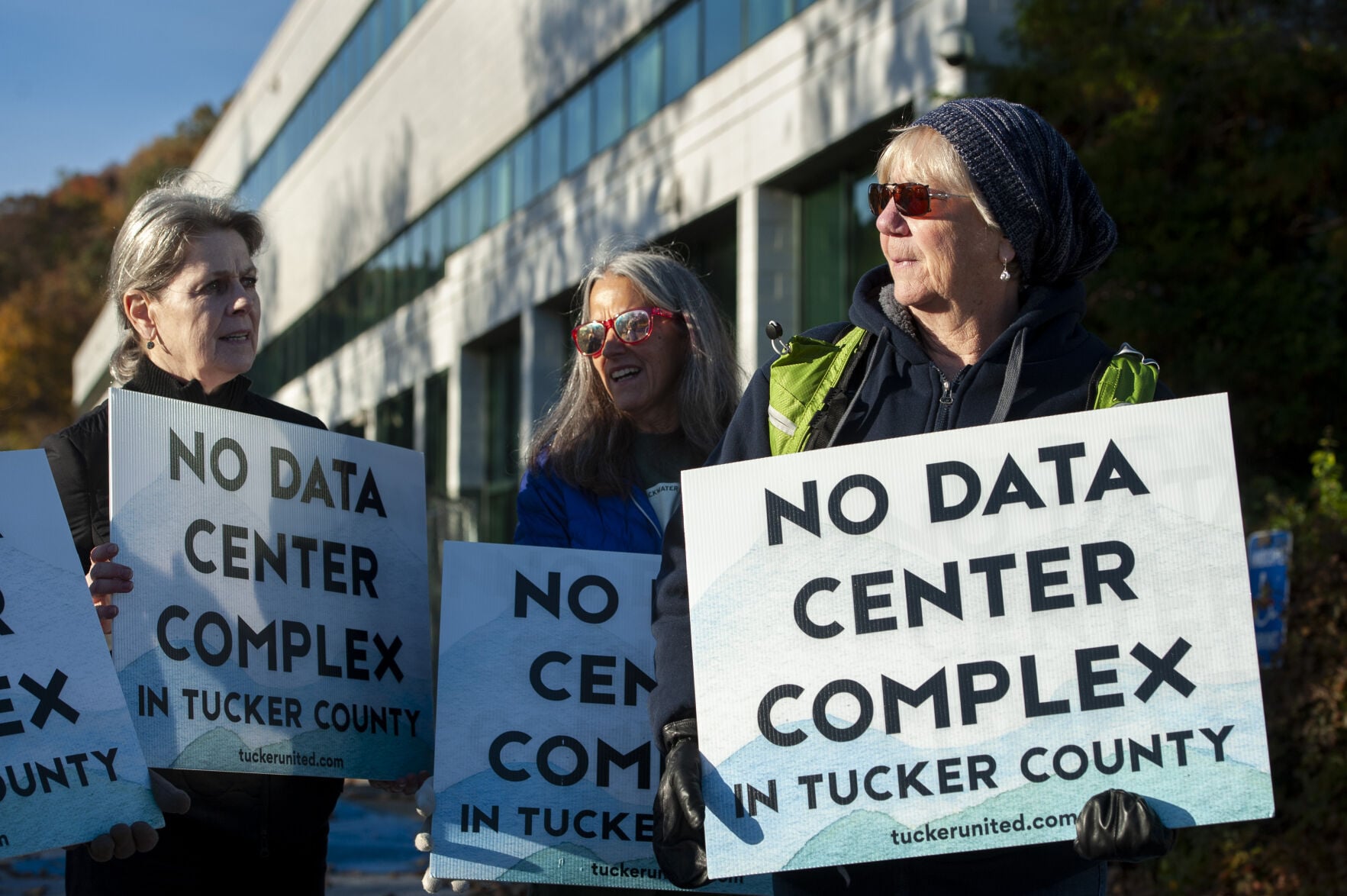
Jill Wilson (from left), Deb Mattingly and Kathy Hackney demonstrate on Nov. 5, 2025, outside a West Virginia Air Quality Board hearing at the state Department of Environmental Protection’s Charleston headquarters. The hearing was in response to community and environmental advocates’ appeal of DEP approval of an air quality permit application for an expected data center in Tucker County.
LAURA BILSON | Gazette-Mail
Editor’s note: This report was supported by the Pulitzer Center and is part of a Gazette-Mail series on drinking water quality in West Virginia.
Jamie Jacobs and her husband split time between Morgantown and the Canaan Valley. They planned a move to the latter full-time.
“[Then] this whole Fundamental Data thing came in,” Jacobs said. “So we’re kind of on hold with that.”
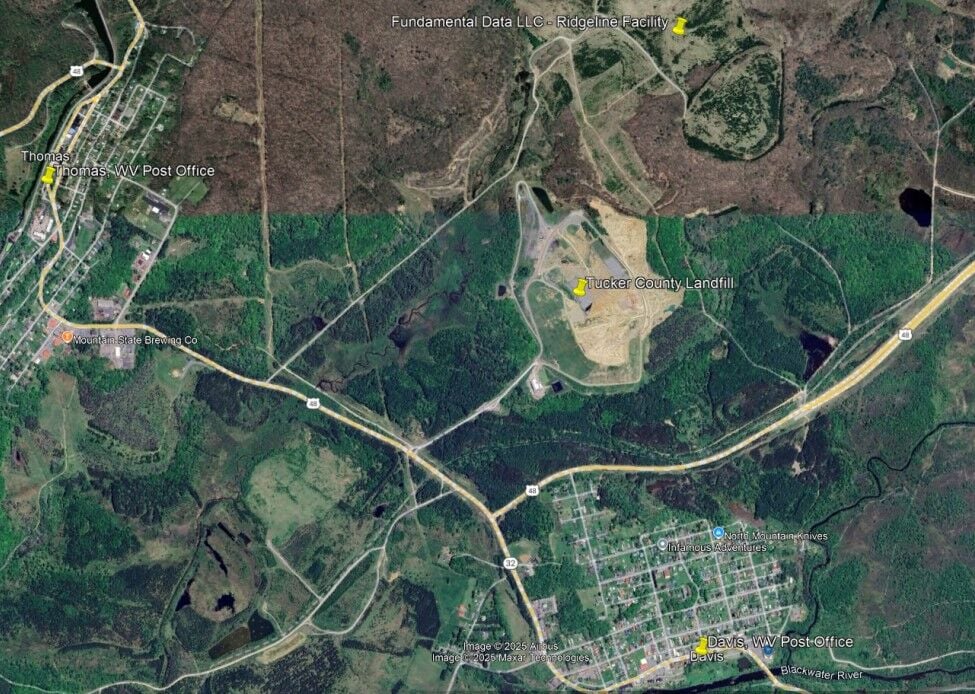
Jacobs was talking about the plan by Purcellville, Virginia-based Fundamental Data LLC to build and operate a gas turbine-powered facility in Tucker County, just downwind from her, expected to be a large-scale data center operation with vast diesel tank storage and the source of a significant increase in air pollution.
Fundamental Data, which has not responded to requests for comment, has been quiet about its plans for the facility, for which the West Virginia Department of Environmental Protection approved an air quality permit in August, despite fervent community opposition.
The company has redacted air emissions-related information throughout its permit application, prompting community and environmental advocates to file an unresolved appeal of the permit approval.
But the environmental health concerns that linger for Jacobs and other Tucker County residents aren’t just about air quality. They’re about water quantity and quality, too.
Large data centers can consume 3-5 million gallons of water per day — roughly 5%-8% of the total amount withdrawn for public water supply throughout West Virginia in 2023, according to DEP data.
The amount of water that could be withdrawn for Fundamental Data’s facility operations has been undisclosed.
Amid a statewide emergency declaration due to drought conditions last summer, the city of Thomas’ town water supply was rendered unusable due to high levels of iron. The state Department of Transportation sent a tanker truck filled with non-potable water to Thomas for washing, flushing toilets and other non-drinking use.
In September, the water utility for the nearby town of Davis, Davis Water Works, informed residents it found elevated levels of lead in drinking water and that lead service lines would be removed by the end of 2026.
“A lot of people have wells. And people are worried [thinking], ‘Is my well going to go dry?’” Jacobs said.
“[T]here’s a lot of water concerns, and I think part of that is the quantity of water that we have available for the people here, but also the quality of those water supplies,” said Nikki Forrester, spokesperson for Tucker United, a coalition of Tucker County residents, including Jacobs, and allies that has opposed the Fundamental Data project.
Those concerns go beyond worries that the three storage tanks approved to hold up to 10 million gallons of diesel each onsite could spill into nearby Pendleton Creek.
Residents also fear any evaporative cooling at the site to keep electronic components from overheating could leave behind high concentrations of salts and other pollutants that worsen the area’s water quality.
In October, the American Water Works Association published a study finding the most prevalent impacts of data centers on water systems include increased water demand affecting sources or treatment capacity, stress on water infrastructure and increased costs.
Clustering of data centers can exacerbate the challenge of planning for peak water demand, especially where there are concurrent demands from other sectors or limits in available supply, the American Water Works Association observed, adding that electricity interruptions stemming from data centers can have major impacts on water utilities.
West Virginia lawmakers were presented with the prospect of a localized power grid that could attract hyperscalers — large-scale data centers with massive computing capability — by Pete Hollis, chief development officer and president of Fidelis-Capio Sequestration, an affiliate of Houston-based Fidelis New Energy LLC, during a Dec. 9 Joint Standing Economic Development Committee meeting.
Hollis suggested to receptive legislators they’ve positioned West Virginia well to usher in development of data center operations like those his company plans to support on a 2,300-acre campus in Mason County, which he pledged would move forward with “cutting of trees [and] moving of dirt” next year.
In 2023, the West Virginia Economic Development Authority approved a forgivable $62.5 million loan with a three-year term for Fidelis subsidiary Mountaineer GigaSystem LLC, which was formed to develop a hydrogen production facility in the Point Pleasant area.
Setting the stage for a power struggle between residents and expected data center support developers was House Bill 2014, a law the Republican-supermajority Legislature passed in April at Gov. Patrick Morrisey’s request aimed at drawing data centers to West Virginia at the expense of local government control and funding.
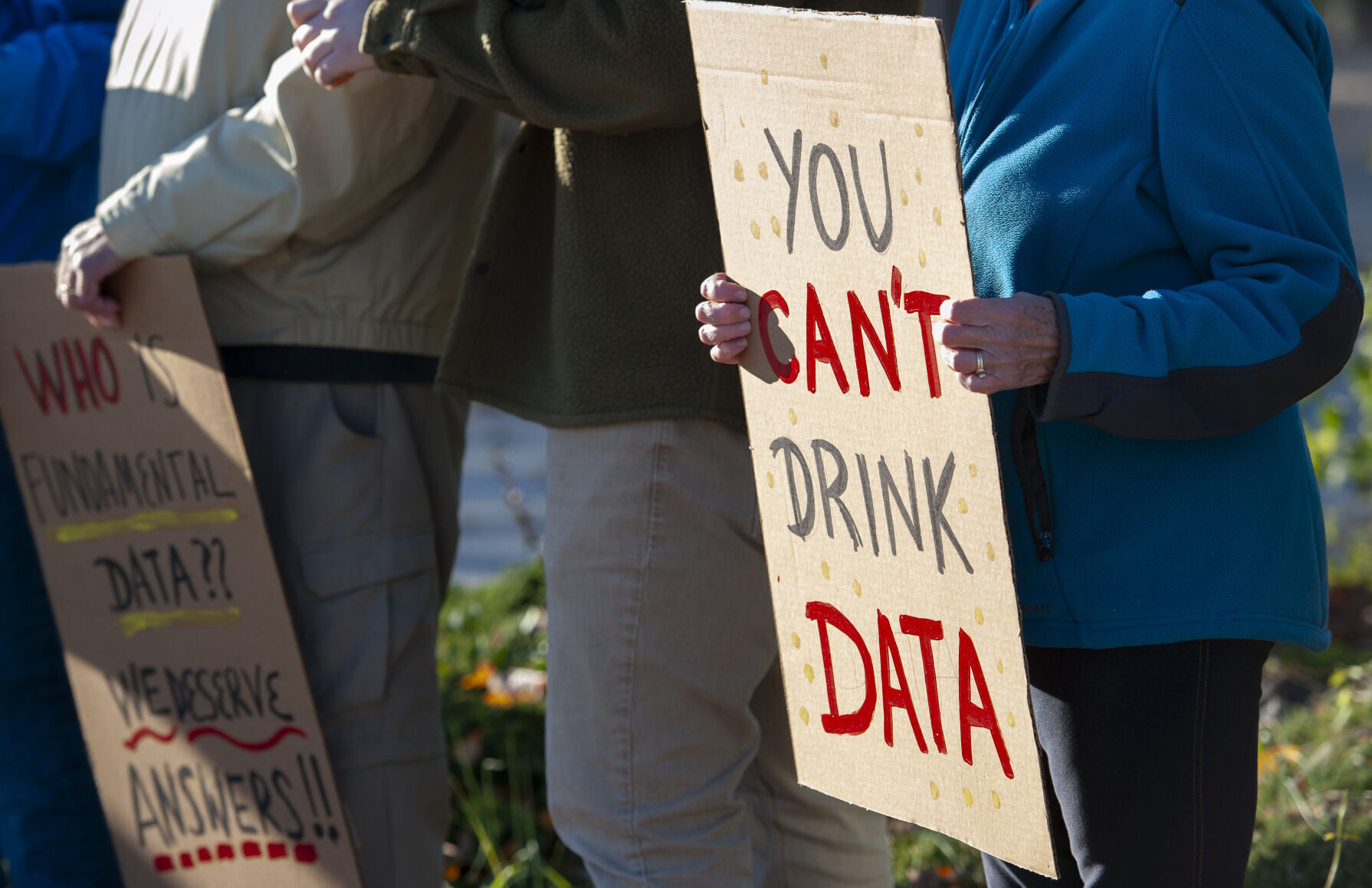
Protesters hold signs before a West Virginia Air Quality Board hearing held on Nov. 5, 2025, in response to community and environmental advocates’ appeal of state Department of Environmental Protection approval of an air quality permit application for an expected data center in Tucker County at the DEP’s headquarters in Charleston.
LAURA BILSON | Gazette-Mail
“I’m really concerned about just the long-term trajectory of what’s happening with these data center buildouts, not just here in Tucker County, but also throughout the state, and thinking about how much water is going to be diverted from people for these computers for out-of-state companies,” Forrester said. “So that’s a major concern. But then there’s also the issue of potential contamination.”
Water contamination isn’t just a potential problem but a persistent reality throughout West Virginia, which has the nation’s highest rate of health-based drinking water violations, according to a Gazette-Mail analysis of United States Environmental Protection Agency data.
The state had the country’s highest percentage of public water systems with health-based federal Safe Drinking Water Act violations — 29.2% — in 2024.
Health-based violations represent the exceedance of maximum contaminant or residual disinfectant levels.
The West Virginia Department of Health said in an emailed response provided by DEP Chief Communications Officer Terry Fletcher that the DOH attributes the state’s comparatively high violation rate to “increased oversight at the state and federal level along with small and disadvantaged public water systems that lack financial resources, have aging or failing infrastructure, lack of system maintenance and overall lack of technical, managerial, and financial capacity.”
Morrisey has characterized the state’s welcome mat rollout for data centers as a move to support the U.S. in a reach for technological supremacy over China amid a global push toward artificial intelligence.
“I’m a believer that America needs to keep pace with what China is doing,” Morrisey said in a news conference Monday.
But West Virginia’s drinking water infrastructure is falling behind.
W.Va. gets D+ grade for drinking water infrastructure
West Virginia got a D+ grade for its drinking water infrastructure in a report card released on Dec. 18 by the American Society of Civil Engineers, one of many poor grades for the state throughout a report card that evaluated the state’s overall infrastructure system.
An accompanying American Society of Civil Engineers report noted West Virginia’s dwindling population presents challenges for utility operators, who face higher operations and maintenance costs due to the growing cost of labor and materials and decreasing revenue from customers. The decreasing revenues are an especially critical constraint since the state’s infrastructure is approaching or past its design life, with high water loss and funding gaps common.
A 2023 DEP report to then-governor and now Sen. Jim Justice, R-W.Va., determined 80 of 469 water systems throughout West Virginia — 17% — were “marginal” or failing while serving over 66,000 people.
The report indicated a long-term decline in the viability of West Virginia water systems, finding 31% had scores that fell by over 10 points while 20% had scores that increased by over 10 points from 2002 to 2023 in a data evaluation to comprise a federally required baseline ranking of the state’s systems. The average viability of West Virginia water systems dropped nine points from 2020 to 2023.
The American Society of Civil Engineers report noted that some systems lose over 50% of water due to leaks, and that the state’s mountainous terrain complicates maintenance.
The West Virginia Infrastructure & Jobs Development Council, a state body that evaluate requests from project sponsors to plan, acquire, design and construct water, sewer and economic development projects and approves funding for those projects, indicated in a 2023 assessment that state needs for water projects totaled $897 million.
Mingo PSD probed by PSC amid data center operation push
Needs for water infrastructure upgrades have been great in Mingo County — where the DEP approved two, nearly identical air quality permit applications for power-hungry facilities to support data center operations.
The DEP in October approved the applications from New York City-based TransGas Development Systems LLC to build and operate the two facilities planned to consist of 117 engines able to operate on natural gas or diesel fuel. Each engine would have a maximum output of 21 megawatts, resulting in aggregate power outputs of 2,457 megawatts for each facility. Of those 117 engines per facility, 114 would operate full-time, with three in reserve.
Those figures would make TransGas’ facilities among West Virginia’s most power-intensive industrial sites.
Ultra-low-sulfur diesel is planned to be stored in 40 tanks on the property near the facilities, per the applications. A natural gas pipeline would feed facility engines.
Community members have expressed worry that TransGas’ planned facilities would negatively affect water quality. Cooling for the proposed facilities would be provided by mine pool water as needed, according to TransGas’ applications, prompting water supply and pollution concerns among local residents. Project critics noted the area already struggles with water access.
TransGas has not responded to requests for comment.
Residents from the Justice area of Mingo County and the Town of Gilbert filed complaints against the Mingo County Public Service District last year alleging frequent water outages, low pressure, water leaks, inadequate water system maintenance, muddy water, lack of boil water notices, fire hydrants not working properly and inadequate customer service.
In January 2025, the PSC issued an order approving a general investigation to determine whether the district could maintain adequate facilities “to provide reasonable, safe, and sufficient service to the public” and whether its management was “grossly and willfully inefficient and unresponsive to the needs of its customers.”
PSC staff prompted the unresolved case by requesting the general investigation, citing state health department violations issued for failures to submit complete and accurate monthly operational reports, comply with primary drinking water regulations and provide customers with boil water notices, address major violations outlined in sanitary surveys, as well as having what staff said in a filing was a “grossly unacceptable” amount of unaccounted-for water loss.
Roughly 600 district customers experienced a prolonged water outage in January 2025, according to the PSC staff, which identified failure to properly maintain sediment basins at the water treatment plant for years as the root of the problem.
“We are without water again,” Stacie Pinson, of Williamson, said in a March 24, 2025, letter to the PSC, recalling writing six formal complaints and reporting a water outage that had added up to four days at that time. “[T]his is getting no attention as we were told it would … We need help here in Mingo County!”
Chandler Orme, of Williamson, said in an April 4, 2025, letter to the PSC the water smelled so strongly of chemicals “it leaves your skin burning and red,” with large particles present in the water.
“I am imploring the state level to do something to fix the many issues plaguing Mingo PSD,” Sabrina Grace, of Williamson, said in a March 26, 2025, letter to the PSC. “I am not one for the state stepping in, but the county level has proven over & over again that they are unwilling to take the necessary steps to do their jobs. It is 2025, we should not be living like we are in a 3rd world county.”
PSC engineering staff recommended a corrective action plan that called for district plans to replace failed and outdated equipment in its plant, alleviate all state regulatory agency violations and safety issues at its plant and in its distribution system, among other requirements.
In a Dec. 19, filing, the district reported $587,000 in funds from the Mingo County Commission to address needed projects and upgrades and pay off or pay down debts owed to vendors, plus a nearly $300,000 West Virginia Water Development Authority critical needs grant to cover system upgrades and installations. The district said its general manager was working with staff to address line flushing and training on preparation and timing of reports.
The general manager, Chris Varney, took over in March and told the Gazette-Mail in a phone interview this month that funding and manpower are the biggest problems plaguing the 15-employee, 5,000-customer district.
“Every problem in the world is some combination of finding money,” Varney said, adding he was working on a redesign process to address the plant’s lack of means to process settled dirt out of water.
The Legislature, Justice, Morrisey and the Water Development Authority, a state revenue bond bank that finances construction of water and wastewater facilities as well as economic development projects, all have been criticized for not committing more funding to clean water initiatives.
The $961 million the state was estimated in the American Society of Civil Engineers’ report to have spent on water and sewer projects over seven years is less than quadruple the $244.5 million the state Treasury projected in September that just the 2026-27 school year budget would be for the Hope Scholarship if 100% of newly eligible students participated in the scholarship — the state’s nonpublic school vouchers program that provides families public money to have their children leave the public school system.
‘We can’t have a real debate’
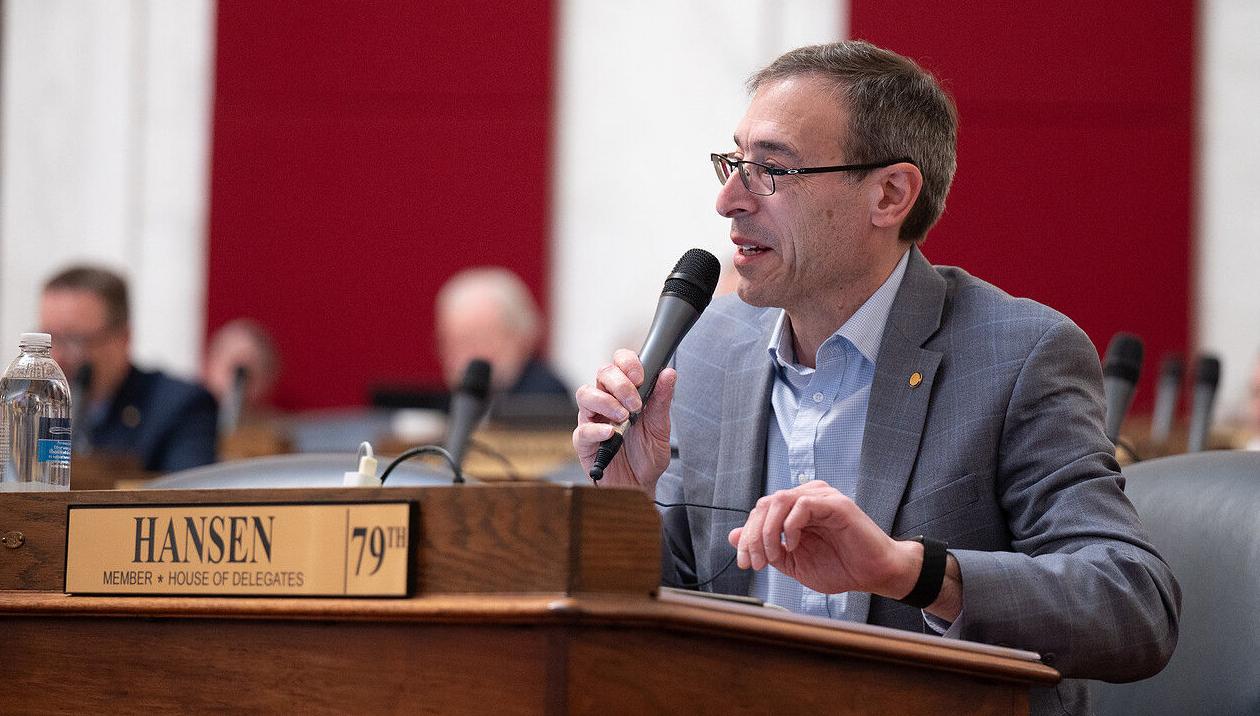
West Virginia Delegate Evan Hansen, D-Monongalia, speaks during the state Joint Energy and Public Works Committee’s Monday, Dec. 8, 2025, meeting in Charleston.
PERRY BENNETT | W.Va. Legislative Photography
Delegate Evan Hansen, D-Monongalia, told the Gazette-Mail he is crafting legislation for the upcoming 2026 regular legislative session that would require data centers to make public their planned water sources and water withdrawal amounts before they can be certified as data centers under HB 2014.
HB 2014 prohibits local jurisdiction over “high-impact” data centers and diverts most of any property tax revenue they would generate away from local taxing bodies, a move estimated to cost counties and school districts millions.
The state has set a DEP-overseen minimum reporting threshold of 300,000 gallons withdrawn from surface or groundwater sources in any 30-day period for water users. But Hansen’s aim is to require data centers to disclose planned water withdrawal information before those withdrawals occur.
“It’s really important for us to understand how these data centers may or may not impact drinking water,” Hansen said in a phone interview, “and we can’t have a real debate about that until these companies disclose where they’re getting their water from and where they’re going to be discharging it, too.”
West Virginians have long had reason to question their drinking water. Now many say that when it comes to community trust, developers of expected data center operations already have poisoned the well.
“Are we going to attract the state-of-the-art, good neighbors,” Jacobs asked, “or are we going to attract something else?”