
2026 marks SOM’s 90th anniversary—a legacy that includes decades of advancing sustainable design practice. Where does the Sustainable Engineering Studio fit within the firm’s long trajectory of environmental design?
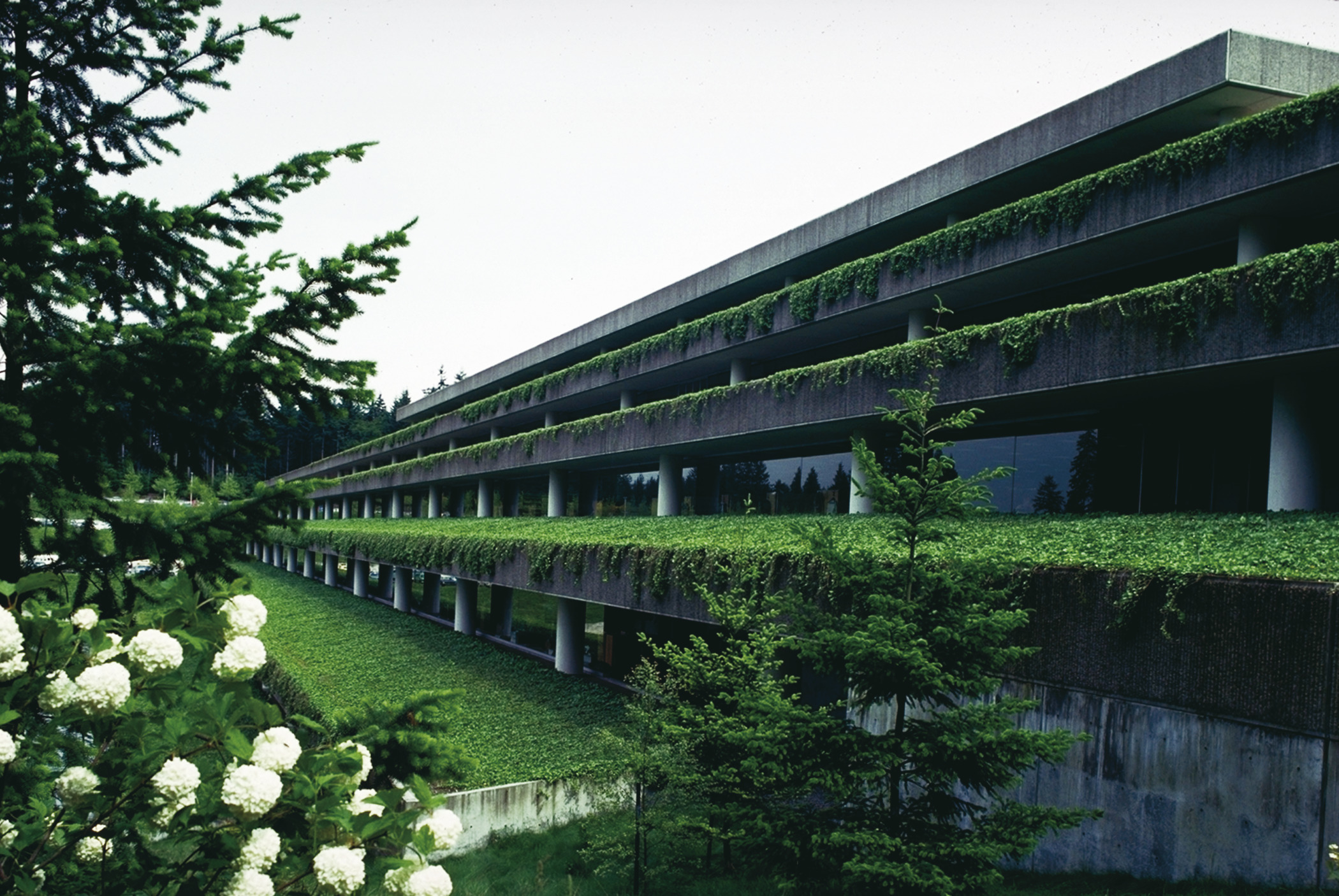
Marzia Sedino: SOM was founded as an interdisciplinary practice, and engineering has always been central to our work. That collaborative mindset has guided every generation at SOM. Nathaniel Owings, in particular, was ahead of his time in establishing environmental conservation as a core value. He was instrumental in the conservation effort for Big Sur in California in the 1960s, and his activism directly informed our work. SOM was already integrating landscape and architecture for projects like the Weyerhaeuser Corporate Headquarters in the 1970s, and applying inventive, regionally-informed climate strategies as the firm expanded its work globally. By 2011, SOM had a dedicated Sustainable Engineering Studio that emerged from both our mechanical engineering practice and our long-established environmental design approach. So, we’re here very much because of the ethos that our founders established and that has been carried forward by successive generations of architects, engineers, and designers.
Mina Hasman: We can point to dozens of projects that exemplify SOM’s legacy of environmental design—projects like the Hajj Terminal, which demonstrated climate-responsive, passive design decades ago in Jeddah, and The Kathleen Grimm School, the first net-zero-energy school in New York City. Today, SES provides the technical expertise, tools, and leadership, but sustainability is a shared endeavor across the firm. We work alongside architecture, engineering, and planning teams to make sustainability measurable and actionable, aligning around priorities like decarbonization and whole life carbon, and delivering high-performance outcomes that respond to local contexts while advancing a collective ambition.
Shona O’Dea: We’ve taken different paths to get here and be part of this story. Some of us have an architecture background and others come from engineering backgrounds. The thing that binds us is this altruistic passion and desire to minimize the climate impact of the built environment.
What does a holistic approach to sustainability look like in practice?
Marzia Sedino: Sustainability can take different forms for different projects. Our job is to understand what “sustainable” means in each unique situation. We define sustainability goals, find a way to meet those goals, and make sure that vision is maintained till the end. For instance, before even starting design work, we might guide our clients in deciding between renovation and new construction, with an understanding of the environmental impact of each choice. We carry this focus all the way through working with design teams to select finish materials.
Mina Hasman: A holistic approach means sustainability isn’t just a checklist. We use data to guide design teams in understanding the carbon impact of their choices, while preserving the design intent. We’re shaping massing and facade strategies, reducing energy demand, finding ways to reuse water, and so much more—ultimately helping reach a project’s operational and embodied carbon targets. And we are designing for flexibility, so buildings can be adapted and remain useful over time.
Shona O’Dea: Every design decision is interdependent. Our team acts as a unifying force between architects, planners, engineers, and clients, pushing them to create something different that they may have never done before.
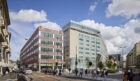
Mina Hasman: A recent headquarters retrofit project in Milan, led by our London office, is a great example of that. We were dealing with a 1960s heritage building complex in need of modernization. We wanted to preserve the spirit of the original architecture while transforming the buildings from within. Our team proposed a strategy to repurpose existing facade materials, including portions of red granite which needed to be replaced due to damage and wear. The granite panels were carefully demounted, processed, and repurposed as aggregate in a new glass fiber reinforced concrete facade system, with a distinctive red hue and texture that recalls the original design. In the end, we were able to preserve 70 percent of the existing structure and materials of the original buildings, significantly reducing the project’s embodied carbon impact. We were thrilled to have a client who was receptive to our ideas and was willing to do something unconventional.

How do you collaborate to lead sustainable design efforts across a global firm—working in cities and regions with different climate and policy considerations?
Mina Hasman: Collaborating across a global firm means translating shared climate ambitions into locally relevant solutions. We stay grounded in core commitments—like the AIA 2030 Commitment and SOM’s own goal to achieve net zero whole life carbon in all our active work by 2040—while adapting our approach to each local context.
A four-season climate might prioritize envelope performance and seasonal energy balance, while a tropical climate focuses on passive cooling, shading, and humidity control. The varying climates and regional regulations we work in shape the pathway to reach our goals.
Marzia Sedino: The fact that we come from different regions and backgrounds, with experience working in every region in the world, is a strength for this group. Each member of our studio brings their own base of knowledge.
Shona O’Dea: And, spreading our team across the world allows us to specialize in the opportunities and challenges of different regions. For my projects in California, we follow strict codes requiring us not only to meet high seismic requirements but also to provide embodied carbon data as part of the permitting process. That itself requires specific knowledge of supply chains for building materials, and in SES we analyze those chains to support the permitting—as we did recently for a major expansion of student housing at UC Santa Barbara. The law challenges us to continue reducing emissions, so it’s a constant vetting process.
In 2023, SOM launched a new Whole Life Carbon Consulting service, applying our methodology to track whole life carbon emissions from the start of a project and throughout its life cycle. How is this approach changing conversations with our clients around sustainability goals and outcomes?
Mina Hasman: Launching Whole Life Carbon Consulting is about anticipating where the industry needs to go, and proactively preparing us to lead. It shifts the conversation from efficiency to total climate impact over time, holding ourselves and our clients accountable through measurable, lifecycle-based targets. Nearly 80 percent of a new building’s emissions come from construction, and Whole Life Carbon Consulting places critical decision-making at the earliest stages, when it matters the most. It also shows us when we might have to make tradeoffs, and aligns projects with policies such as the European Union Taxonomy and New York’s Local Law 97. Ultimately, it turns sustainability into a quantifiable performance metric tied to long-term value, risk, and impact.
Marzia Sedino: This service is also helping us collect data on a project’s performance at every stage of the process much faster. That creates value for our clients, because it helps us quickly understand how we can meet a project’s sustainability goals in a cost-effective way, and to take the knowledge we gain and apply it to other work across the firm.
Shona O’Dea: Our evaluations occur both before and after construction. We’re doing post-occupancy studies to learn which ideas were successful, and which ones we can improve. We can do this for our own projects and for clients who’d like a review of an entire portfolio. For existing buildings, we can determine their carbon story and help move in the right direction.

SOM has a long history of investing in research and technology, often in collaboration with experts outside our profession. Can you tell us how you’re working to integrate new technological advances in your work?
Mina Hasman: Technology is a key enabler for decarbonization, but only when it’s fully integrated into the design workflow. We’ve developed platforms like our Environmental Analysis Tool to rapidly test thousands of scenarios and identify low-carbon pathways early, turning months of analysis into hours. We are also advancing material and systems innovation—from low-carbon concrete strategies explored through our work on Urban Sequoia, a concept for a carbon-absorbing building, to electrification and high-performance MEP systems. Crucially, we pair these tools with collaboration across industry and research partners, ensuring innovations are practical, scalable, and truly deliverable.
Shona O’Dea: The future of sustainable design depends on our ability to capture project data and learn from it. The data we’re tracking through our Whole Life Carbon Consulting is part of a broader initiative: our SES Data Hub. This platform brings together data on energy, carbon, and post-occupancy insights and uses AI to make it structured, searchable, and comparable. By linking design intent with real-world performance, it enables faster decision-making, reduces friction in workflows, and helps us continuously refine how we deliver net zero at scale.
Marzia Sedino: The Data Hub is going to be a game changer. It’s emblematic of the investment SOM has put into this group. And our firm’s partnerships with innovative companies—like the algae-based bio-concrete developed with Prometheus Materials and gravity-based energy storage systems with Energy Vault—reflect our ethos of continued invention. These are efforts that reflect a willingness to constantly challenge typical ways of doing business, and it is this type of thinking that will help the building industry reach net zero whole life carbon in the future.