Virtual sensors help to design more efficient cars – Innovation Origins
Nowadays’ cars produce a vast stream of data. Virtual sensors can help in usign this information to know more about our vehicle.
Thank you for sharing this story! However, please do so in a way that respects the copyright of this text. If you want to share or reproduce this full text, please ask permission from Innovation Origins (partners@innovationorigins.com) or become a partner of ours! You are of course free to quote this story with source citation. Would you like to share this article in another way? Then use this link to the article: https://innovationorigins.com/en/virtual-sensors-help-to-design-more-efficient-cars/
A modern car produces a vast stream of information, from the thousands of data points in the vehicle. A German company has developed a system to collect all that data and to reuse it to generate new information, helping cars manufacturers to develop more efficient components. The system does so via what is known as a cloud-to-cloud connection, without any physical device on the vehicle.
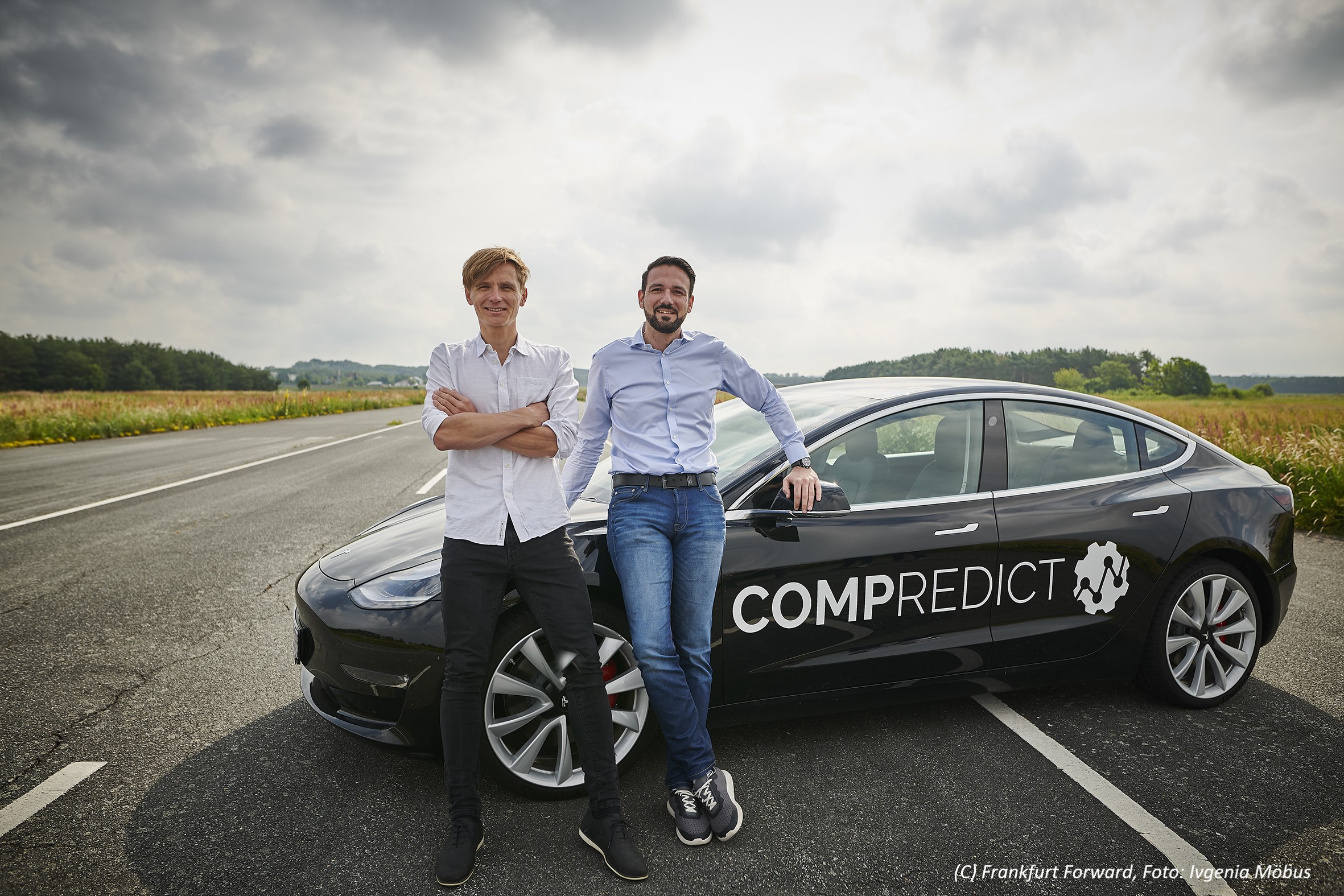
COMPREDICT is the start-up behind the software. It was founded in 2016 within the Technische Universität Darmstadt by Dr. Ing. Rafael Fietzek and Dr. Ing. Stéphane Foulard. The firm provides its system to other companies – including car manufacturers, telematics companies and fleet operators.
Virtual sensors can measure the dynamic behaviour of components such as batteries, brakes, and powertrains. They offer insights on how vehicles are used and how they perform, which enables predictive maintenance and improved components design.
Thank you for sharing this story! However, please do so in a way that respects the copyright of this text. If you want to share or reproduce this full text, please ask permission from Innovation Origins (partners@innovationorigins.com) or become a partner of ours! You are of course free to quote this story with source citation. Would you like to share this article in another way? Then use this link to the article: https://innovationorigins.com/en/virtual-sensors-help-to-design-more-efficient-cars/
Considering the enormous amount of information coming out from today’s cars, the system needs to know what data to choose from. “We designed an entire machine learning infrastructure, gathering all the data that cars collect. The Artificial Intelligence (AI) is trained to get the right information, and it does so by selecting the right features out of more than 20,000 different data points in the car”, explains Fietzek.
The system tracks components’ lifespan to check how they perform in real-life use and how to design more sustainable devices. This way, a devices’ ecological footprint can be reduced, as waste is minimised as well as any replacements costs. In this respect, the system improves failure prediction which enables companies to predict maintenance times more precisely.
COMPREDICT’s system is suitable for different kinds of applications on vehicles. It can be integrated into existing telematics solutions, showing users real-time data from the vehicle.
Thank you for sharing this story! However, please do so in a way that respects the copyright of this text. If you want to share or reproduce this full text, please ask permission from Innovation Origins (partners@innovationorigins.com) or become a partner of ours! You are of course free to quote this story with source citation. Would you like to share this article in another way? Then use this link to the article: https://innovationorigins.com/en/virtual-sensors-help-to-design-more-efficient-cars/
A modern car produces a vast stream of information, from the thousands of data points in the vehicle. A German company has developed a system to collect all that data and to reuse it to generate new information, helping cars manufacturers to develop more efficient components. The system does so via what is known as a cloud-to-cloud connection, without any physical device on the vehicle.
COMPREDICT is the start-up behind the software. It was founded in 2016 within the Technische Universität Darmstadt by Dr. Ing. Rafael Fietzek and Dr. Ing. Stéphane Foulard. The firm provides its system to other companies – including car manufacturers, telematics companies and fleet operators.
Virtual sensors can measure the dynamic behaviour of components such as batteries, brakes, and powertrains. They offer insights on how vehicles are used and how they perform, which enables predictive maintenance and improved components design.
Thank you for sharing this story! However, please do so in a way that respects the copyright of this text. If you want to share or reproduce this full text, please ask permission from Innovation Origins (partners@innovationorigins.com) or become a partner of ours! You are of course free to quote this story with source citation. Would you like to share this article in another way? Then use this link to the article: https://innovationorigins.com/en/virtual-sensors-help-to-design-more-efficient-cars/
Considering the enormous amount of information coming out from today’s cars, the system needs to know what data to choose from. “We designed an entire machine learning infrastructure, gathering all the data that cars collect. The Artificial Intelligence (AI) is trained to get the right information, and it does so by selecting the right features out of more than 20,000 different data points in the car”, explains Fietzek.
The system tracks components’ lifespan to check how they perform in real-life use and how to design more sustainable devices. This way, a devices’ ecological footprint can be reduced, as waste is minimised as well as any replacements costs. In this respect, the system improves failure prediction which enables companies to predict maintenance times more precisely.
COMPREDICT’s system is suitable for different kinds of applications on vehicles. It can be integrated into existing telematics solutions, showing users real-time data from the vehicle.
innovationorigins.com