Darren Tan did not always dream of working in the rail industry. A Monash University computer science graduate who went on to complete a Master’s degree in Cybersecurity, one of his main interests was Artificial Intelligence (AI).
But his horizons broadened when the Monash Institute of Railway Technology (IRT) recruited him while he was midway through his post-graduate studies.
“I didn’t know much about rail until I started working with IRT,” he said. “I realised the rail sector actually presents a great opportunity to apply AI.”
Tan started working part-time while finishing his master’s, and is now a senior data scientist with IRT’s innovation team.
Day-to-day, his work centres on software development for an AI system that monitors track health across heavy haul networks.
The system uses sensors mounted on rolling stock to capture photographic data at high speed as trains move along the track. This assesses the condition of rail components in real time, with AI algorithms flagging any potential issues or defects.
This has a host of benefits. The need for manual track inspections is reduced – meaning fewer track possessions, less downtime for trains, and fewer workers needed out on the tracks, which can be a potentially hazardous environment.
Tan leads the software side of the operation, while a broader team handles the hardware – the sensors and their installation.
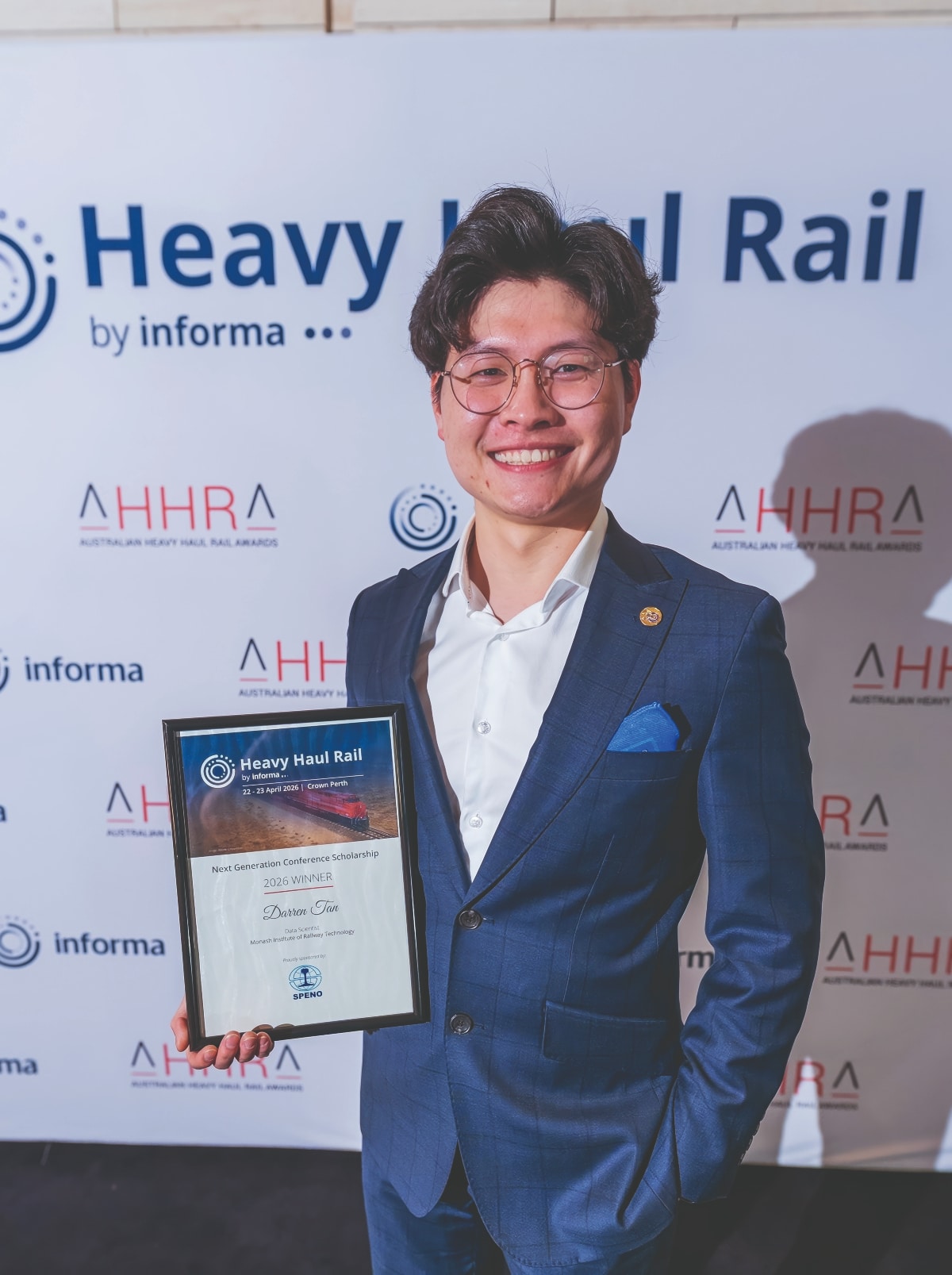
When it comes to using AI to boost productivity and safety in rail, he likes to think outside the box. As part of a scholarship application to the 2026 Heavy Haul Rail Conference in Perth, he submitted a new concept, RailMind, which builds on the foundation of what he does at IRT. While IRT’s current system exclusively uses photographic data, RailMind envisions a platform that draws from a range of different sources, including visual and auditory data, maintenance records, financial reports and inspection logs.
It then consolidates all this information into a single source, which the AI uses to produce valuable insights. This saves time and money, as it would otherwise require analysts to manually bring together data from multiple systems.
“For example, you can tell the AI that you are intending to carry out some rail upgrades and ask it which section of the track should be prioritised,” Tan explained.
AI will offer recommendations, but the decision about which upgrades are carried out will be with the track manager. Tan is clear the role of AI is as a decision-support tool, with people still making the final call.
“AI provides recommendations and insights, but it’s still up to humans to analyse the information and justify their decisions,” he said. “RailMind accelerates this process rather than replacing it.”
Tan said there is still some uncertainty in the rail industry around AI and how it can be useful.
“The challenge is in building confidence in the technology, demonstrating that AI is a tool that can aid people, and guiding users in its safe and effective application,” he said.
“People are still the primary gateway in asking ‘Is this a real defect or not?’
“Safety is always the priority. You can’t use AI to replace track inspections entirely.”
The rail industry in Australia is currently suffering from a skills shortage and a retirement cliff. Tan said it’s a great sector to work in but often gets overlooked.
“In university, you don’t hear much about the rail industry,” he said. “Most universities don’t offer the option to specialise in rail engineering.
“I think companies need to reach out to graduates. Rail has been around for so many years, but it gets forgotten. We need to think about how we market it and show how interesting it can be.
“It’s just a matter of getting the right people to bridge this gap.”
