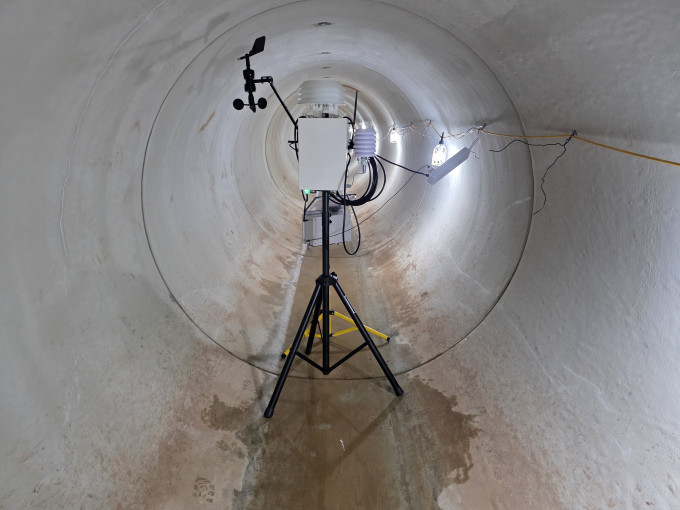
Prototype IoT sensor for the underground environmental risk management system developed by the Korea Institute of Civil Engineering and Building Technology. Provided by KICT
A system has been developed that helps workers in underground spaces such as tunnels and utility corridors detect the risk of toxic gases in advance and evacuate in time.
The Korea Institute of Civil Engineering and Building Technology (KICT) announced on the 2nd that it has developed an “underground environmental risk management system” that can measure toxic gases and oxygen concentration in real time at underground construction sites and predict changes in risk using artificial intelligence (AI).
As cities grow larger and more complex, the number of underground spaces is increasing, including tunnels, utility corridors, and power ducts that carry electrical lines and cables.
At underground construction sites, processes such as excavation and blasting, welding, painting, and operating diesel-powered equipment can generate carbon monoxide, hydrogen sulfide, volatile organic compounds (VOCs), and dust.
It is known that asphyxiation accidents occurring in confined spaces such as underground facilities or water tanks have fatal outcomes, with one out of every two victims dying. Between 2014 and 2023, 136 of the 338 people who suffered industrial accidents due to asphyxiation in confined spaces died.
In underground spaces where ventilation is difficult, toxic gases can spread quickly or oxygen concentration can drop, making it important to continuously monitor the work environment and respond proactively to risks.
The research team led by Senior Researcher Kim Young-seok of KICT’s Geotechnical Engineering Research Division combined Internet of Things (IoT) sensors with AI prediction technology to develop a system that collects environmental information from underground spaces in real time and predicts changes in toxic gas concentration and high-risk zones.
The underground environmental risk management system collects in real time data such as toxic gas concentration, temperature, humidity, and airflow measured on site, and analyzes them using AI. It can estimate gas concentrations even in sections where sensors are not installed, and predict both the direction of toxic gas dispersion and its point of origin.
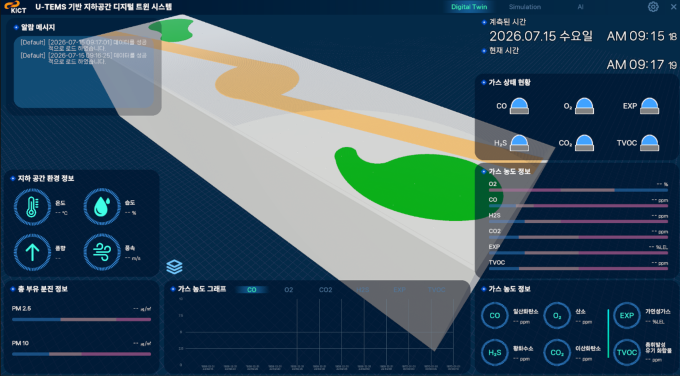
Dashboard of the underground environmental risk management system. Provided by KICT
The research team validated the system’s performance through indoor experiments that reproduced various environments and tests conducted in actual large-diameter conduits and underground passage-type tunnels. Using measurements from just two sensors, the system estimated the gas concentration distribution at 14 locations. It also identified the section where gas was generated based on data collected for about 30 seconds after the onset of gas emission.
KICT President Park Sun-gyu said, “This technology is meaningful in that it enables workers to recognize invisible risks in underground work environments in advance and secure time to respond,” adding, “Starting with tunnels, we will apply it to a variety of underground spaces to help prevent serious accidents at construction sites.”
Copyright ⓒ DongA Science. All rights reserved.

