
Domingo Gaces Samontina, Jr.
Independent Researcher, Construction Information Management
Abstract—Daily Activity Reports (DARs) are contemporaneous construction records used to document site activities, resources, working conditions, progress, inspections, safety events, delays, instructions, and other factors affecting project execution. This paper proposes a structured framework for assessing DAR completeness and information quality. The framework introduces a weighted DAR Completeness Score (DCS) based on fourteen categories: report identification; weather and site conditions; work activities; quantitative progress; manpower; plant and equipment; materials; quality and inspection; safety and environmental information; delays and constraints; instructions and communications; photographic evidence; action ownership; and verification. Each category is rated on a five-level scale and converted into an overall score from 0 to 100. Submission timeliness and reporting continuity are assessed separately to distinguish document availability from content completeness and punctuality. The framework is grounded in literature on construction daily-report analytics, multimodal evidence, quality knowledge management, intelligent information systems, and electronic document management. It is intended to strengthen progress verification, productivity assessment, quality and safety monitoring, delay analysis, claims substantiation, and data-driven project control.
Keywords—construction daily reports, construction documentation, document control, project controls, site diaries, traceability, completeness assessment, construction analytics
I. INTRODUCTION
Construction projects operate in changing environments in which labour, equipment, materials, inspections, design information, weather, safety requirements, and interfaces influence planned production. Daily Activity Reports (DARs), also called construction daily reports or site diaries, preserve these events as contemporaneous project records. Their value depends not only on whether a report exists, but also on whether its content is complete, measurable, timely, and traceable.
Recent IEEE research demonstrates that daily-report information can support more advanced applications. Daily report datasets have been investigated for construction-delay prediction [1], while multimodal artificial intelligence has been used to generate quality-assurance descriptions from site images [2] and to improve safety-oriented image descriptions in daily construction records [3]. These developments depend on reliable source data. Incomplete activities, unlabelled photographs, missing locations, and absent time or resource information weaken both human review and automated analysis.
Construction information-management research further emphasizes the need for organized digital records. Intelligent engineering information systems can consolidate fragmented project data [4], electronic document-management systems improve storage, coordination, retrieval, and sharing [5], and recent work on construction quality knowledge management identifies structured knowledge capture as a continuing industry need [6]. Accordingly, this paper proposes a repeatable completeness-based method for assessing DAR information quality.
II. RESEARCH OBJECTIVES
The objectives are to: (1) explain the project-control importance of DARs; (2) identify the minimum information required for a comprehensive format; (3) establish a weighted DAR Completeness Score; (4) define timeliness and continuity indicators; and (5) provide an information architecture suitable for dashboards, analytics, evidence retrieval, and future automated processing.
III. REVIEW OF RELATED LITERATURE
The literature indicates a shift from static reports toward reusable project data. A feasibility study on applying big data to daily reports considered prediction of construction delay situations [1]. This supports the inclusion of explicit delay causes, durations, affected activities, and mitigation actions in a structured DAR.
Image evidence has also become a significant research area. Multimodal GPT has been applied to construction-site image description for quality assurance [2], and multimodal prompting has been investigated for automated safety descriptions in daily construction reports [3]. These studies support the requirement that site photographs carry identifiers, dates, locations, activities, and concise descriptions rather than appearing as unstructured attachments.
Beyond individual reports, intelligent construction information systems seek to integrate engineering data for efficient management [4]. Research evaluating electronic document management in construction reported benefits related to document control, retrieval, sharing, security, visualization, and project quality, while also identifying knowledge and adoption barriers [5]. A recent IEEE review of construction quality knowledge management similarly highlights the importance of capturing, sharing, and reusing quality knowledge [6]. The proposed DCS connects these themes by treating each DAR as both a formal document and a structured data source.
A. Digital Transformation and Structured Construction Information
Recent reviews position construction digital transformation as an organizational and information-governance challenge rather than only a technology-adoption exercise. A systematic IEEE review of the building construction industry found recurring attention to Building Information Modelling, Internet of Things, cloud platforms, artificial intelligence, and integrated information environments [7]. An integrative review published in 2025 similarly identified management support, digital-oriented culture, customer requirements, BIM, cloud computing, and IoT as important drivers and interventions, while reporting benefits in cost accuracy, efficiency, quality, and long-term competitiveness [8]. These findings support a DAR design that uses standardized fields, controlled identifiers, and reusable data instead of isolated narrative records.
The sector nevertheless continues to face uneven implementation. The RICS Digitalisation in Construction Report 2024 describes mixed adoption alongside persistent barriers involving cost, skills, and collaboration [9]. For daily reporting, this means that a technically capable platform cannot compensate for unclear ownership, inconsistent entry practices, weak verification, or poor data quality. A completeness framework therefore needs to evaluate both process discipline and technical content.
B. Automated Monitoring, Visual Evidence, and Multimodal AI
The research frontier increasingly combines textual site records with images, sensors, BIM, and machine learning. A 2025 systematic review of deep-learning-enabled visual computing examined 144 publications and identified object detection, safety, damage detection, quality, and productivity analysis as major application domains [10]. More recent reviews address multimodal large language models and multimodal machine learning across the architecture, engineering, and construction lifecycle [11], [12]. These approaches reinforce a central requirement of this study: photographs should not be treated as decorative attachments. Each image should be connected to a date, location, activity, observation, and controlled reference so that the evidence remains interpretable to both reviewers and automated systems.
C. Daily Reporting, Document Control, and Knowledge Reuse
The daily-report studies already cited in [1]–[3] show that structured source records can enable delay prediction and automated descriptions for quality and safety. Electronic document management research further shows that retrieval, coordination, security, and project quality depend on effective implementation and user knowledge [5]. Construction quality knowledge-management research emphasizes capture, sharing, and reuse [6]. Together, this literature suggests that the DAR should function simultaneously as a controlled record, an evidence index, and a reusable dataset.
A recent practitioner article by the present author argues that document control is an information-control function linking design decisions, revisions, submissions, and site execution [13]. This source is included as practitioner context rather than peer-reviewed evidence. Its relevance to the study lies in the operational distinction between successful filing and dependable information flow, which is consistent with the paper’s separation of document-control compliance from technical information completeness.
IV. IMPORTANCE OF DAILY ACTIVITY REPORTING
A. Progress and Productivity
A useful DAR records not only that work occurred, but where it occurred, what quantity was planned and completed, which unit applied, and which resources produced the output. Labour productivity may be represented by
LP = Q / LH, (1)
where LP is labour productivity, Q is completed quantity, and LH is labour-hours. Without quantities and labour-hours, productivity analysis is not reproducible.
B. Delay and Disruption Evidence
A delay entry should identify its cause, affected activity, start and finish, duration, affected labour and equipment, immediate mitigation, responsibility category, and supporting record. This structure improves later schedule review and creates the type of daily-report dataset required for predictive analysis [1].
C. Quality, Safety, and Traceability
DARs should link activities to inspections, tests, drawings, requests for information, non-conformance reports, and corrective actions. Structured image descriptions can improve quality and safety interpretation [2], [3]. The daily report therefore functions as an index connecting field activity to controlled evidence.
D. Document and Knowledge Management
A formally controlled DAR has value only if the underlying technical content is usable. Electronic document management improves access and coordination [5], while intelligent information platforms and knowledge-management approaches increase the potential for reuse [4], [6]. A mature process evaluates both metadata compliance and technical completeness.
V. METHODOLOGY
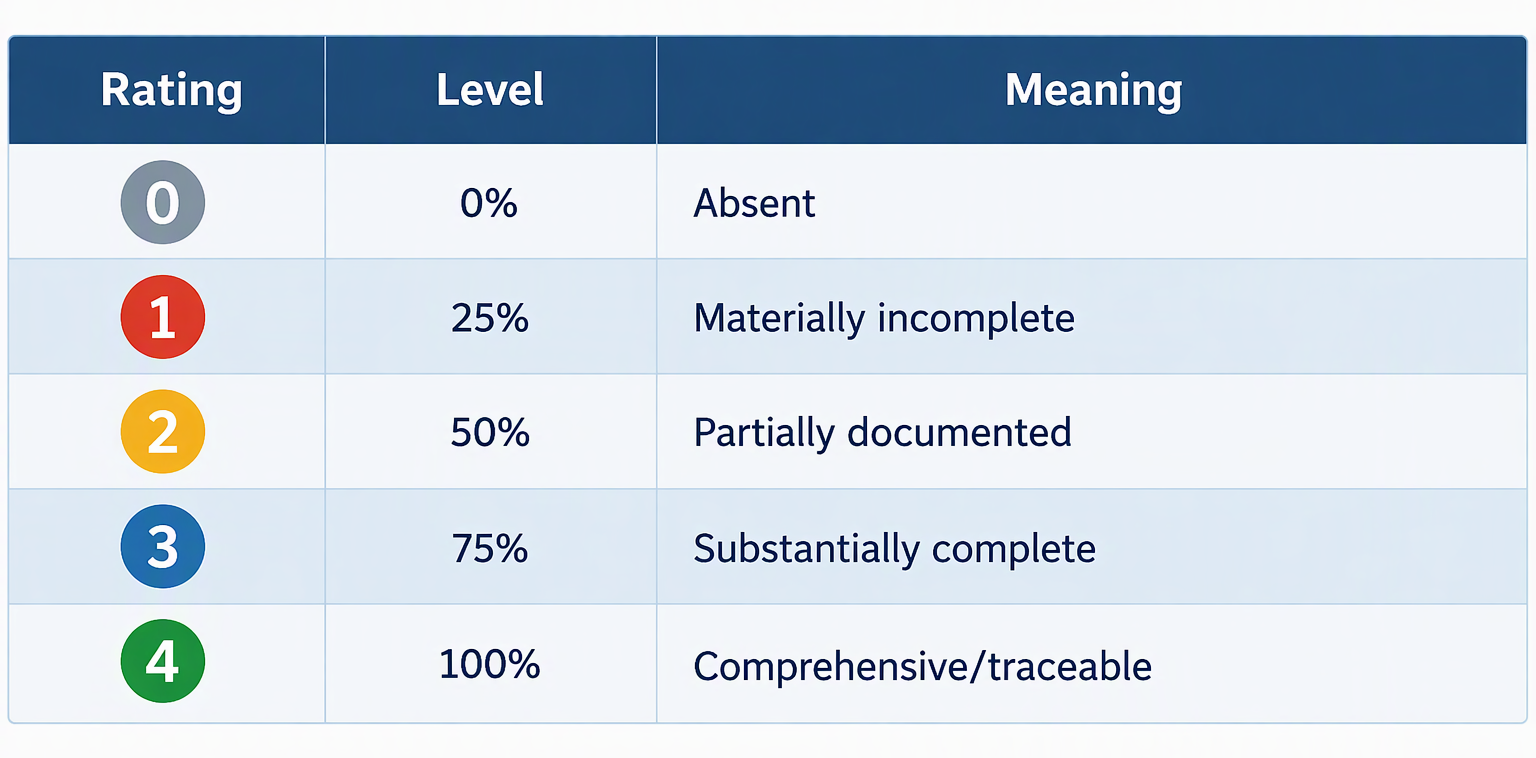
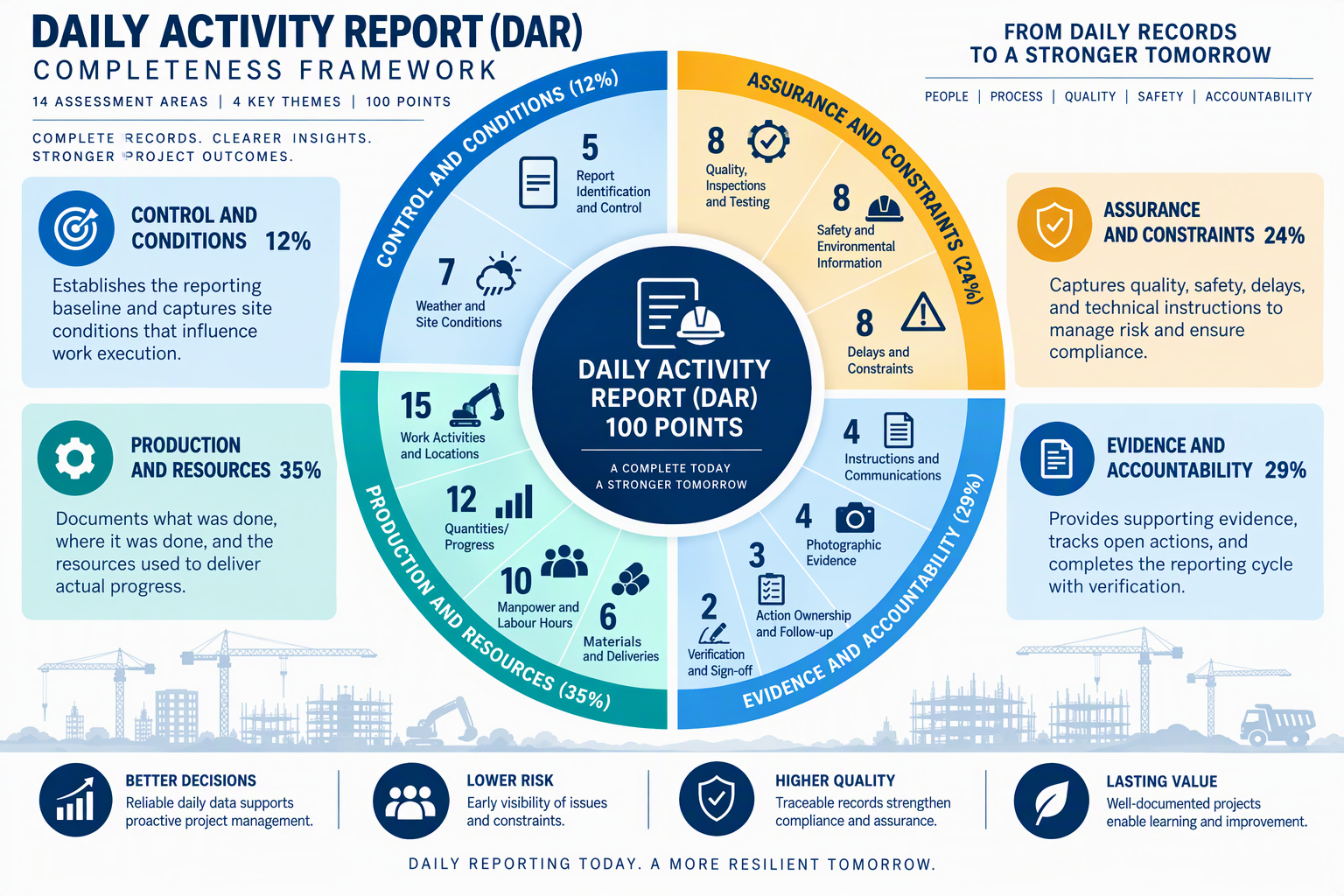
The study uses a document-analysis framework. Each report is assessed against fourteen weighted categories. Reviewers assign a rating from 0 to 4: 0 means absent; 1 means mentioned but materially incomplete; 2 means partially documented; 3 means substantially documented with minor gaps; and 4 means comprehensive and traceable. Category weights reflect their relative importance to construction operations, evidence, and downstream analysis. The proposed weights are a research contribution and are not presented as an existing industry standard.
S_i = W_i (R_i / 4), (2)
where S_i is the category score, W_i is the category weight, and R_i is the rating. The total score is
DCS = Σ(i=1 to 14) S_i, 0 ≤ DCS ≤ 100. (3)
TABLE I. DAR COMPLETENESS SCORING MATRIX
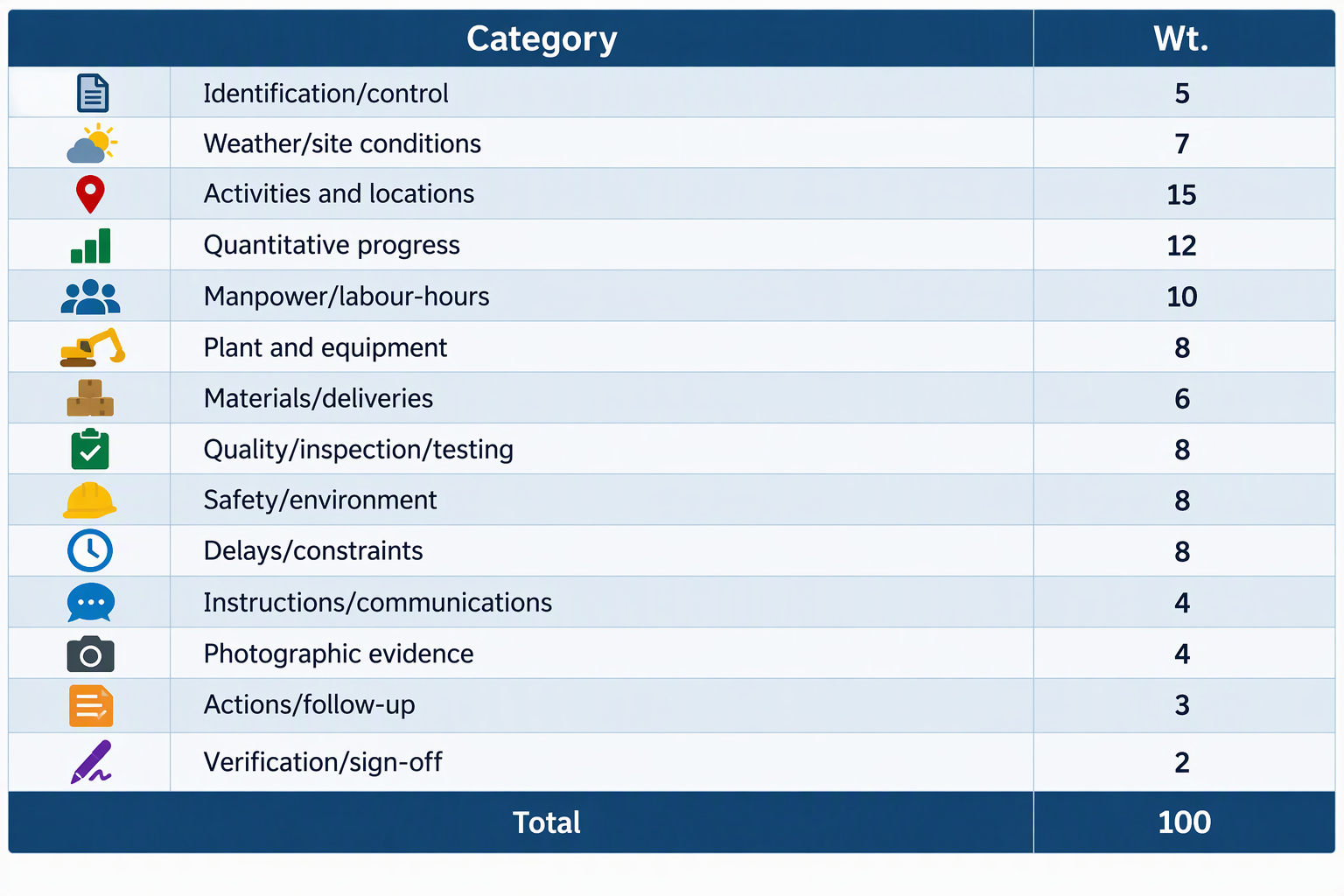
TABLE II. NORMALIZED RATING SCALE
VI. COMPLETENESS CRITERIA
A. Identification and Conditions
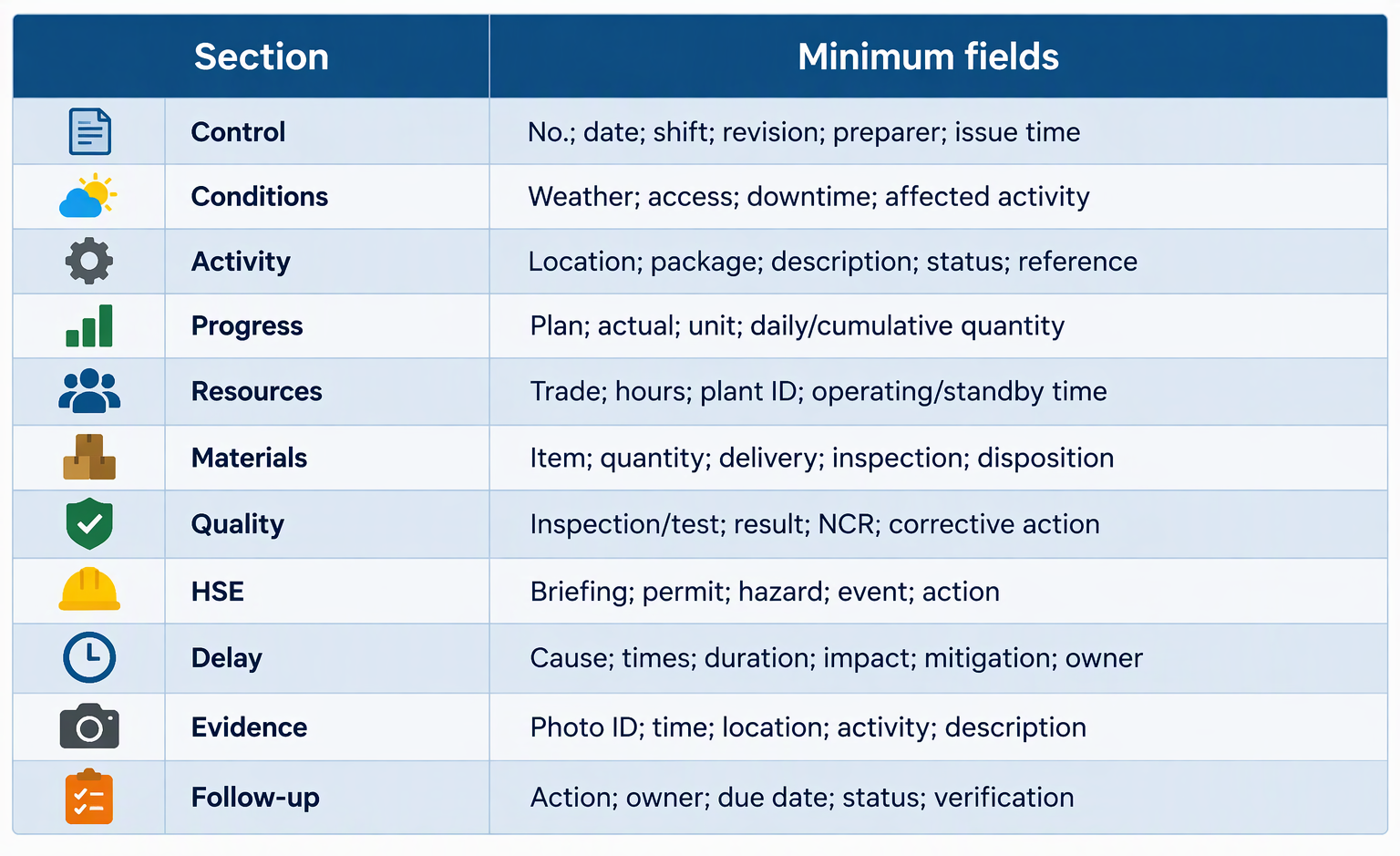
Report identification should include report number, reporting date, shift, preparer, revision, package or area reference, and submission date/time. Conditions should include weather, rainfall, temperature or wind where relevant, access or ground conditions, downtime, and affected work. Merely recording “rainy” is weaker than recording the operational consequence and duration.
B. Activities and Quantitative Progress
Every major work item should state the activity, work location, work breakdown or package reference, applicable drawing, crew, start and finish where needed, status, planned quantity, actual quantity, unit, and cumulative progress where relevant. Quantitative progress is scored separately from activity description because narrative work statements do not necessarily demonstrate measurable accomplishment.
C. Resources and Materials
Manpower information should include trade, supervisory personnel, skilled and general workers, operators, working time, overtime, and labour-hours. Equipment records should include type, quantity or asset identifier, operating hours, standby time, breakdowns, and work location. Materials should capture description, quantity, unit, delivery reference, receipt time, inspection status, acceptance or rejection, and intended work area.
D. Assurance, Constraints, and Accountability
Quality entries should reference inspections, tests, results, observations, non-conformance records, corrective actions, and status. Safety and environmental records should include toolbox meetings, permits, inspections, hazards, near misses, incidents, environmental events, and corrective action. Delays require start, finish, duration, cause, affected activity, impact, mitigation, and reference. Instructions and actions require source, owner, target date, and open or closed status.
E. Photographic Evidence and Verification
Each significant photograph should contain a photo identifier, timestamp, location, activity, view direction where useful, and description. This metadata supports manual review and the types of multimodal analysis investigated in [2] and [3]. Reports should identify the preparer, reviewer or verifier, review date, and revision status.
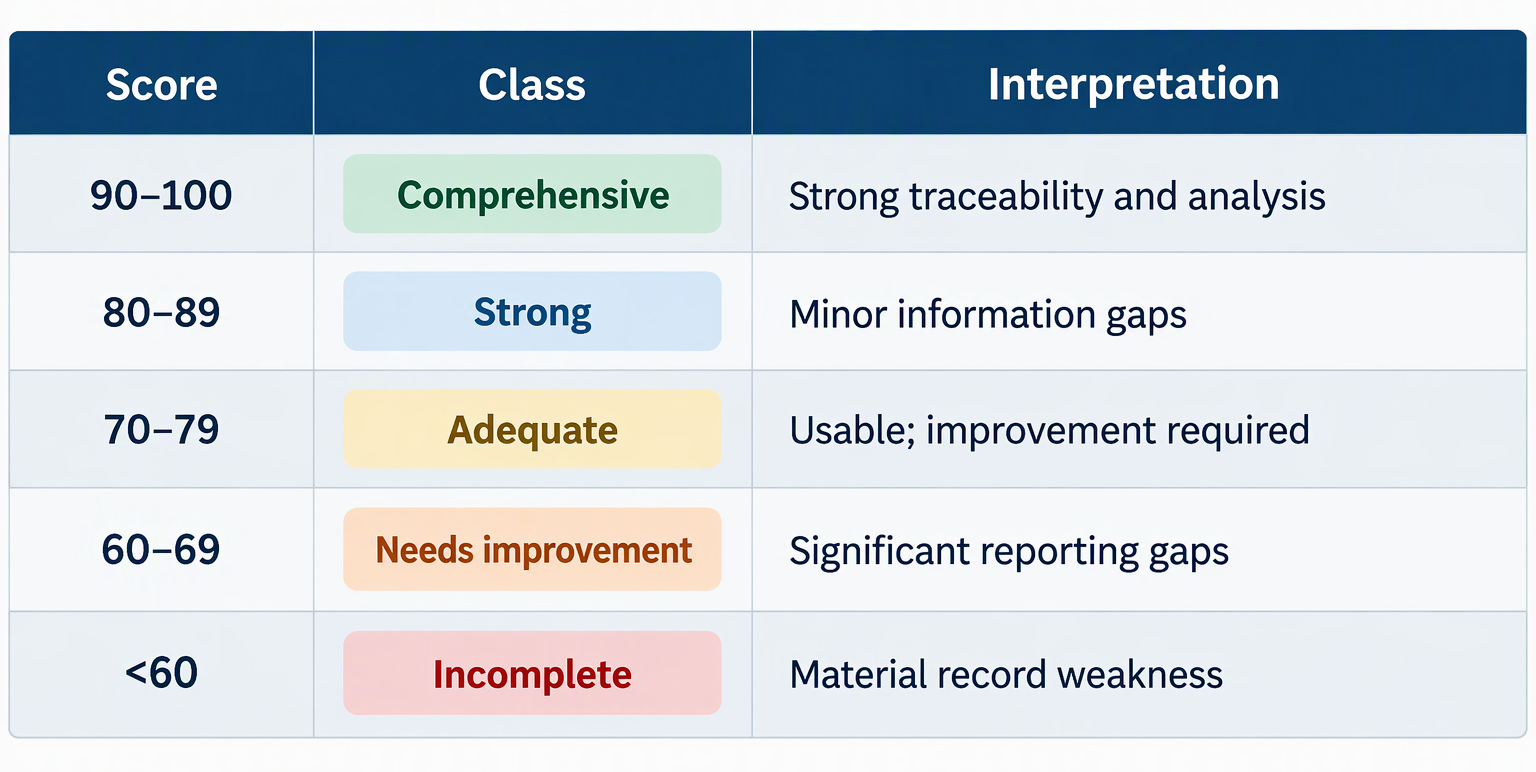
TABLE III. DCS CLASSIFICATION
VII. TIMELINESS AND CONTINUITY
Completeness is assessed independently from timeliness. Submission lag is calculated as
SL_i = SD_i − DD_i, (4)
where SD_i is the formal submission date and DD_i is the activity or document date. A proposed operational classification is: same day, 0 days; timely, 1 day; moderate delay, 2 days; late, 3–5 days; and significantly late, more than 5 days. Contractual requirements take precedence when a project applies a different deadline.
Reporting continuity measures whether reports exist for all expected reporting days:
RC = (DAR_received / DAR_expected) × 100%. (5)
Additional indicators include average DCS, on-time submission rate, quantified-activity rate, evidence-coverage rate, and fully documented delay rate. Together, these measures distinguish receipt, punctuality, and technical information quality.
VIII. PROPOSED COMPREHENSIVE DAR FORMAT
TABLE IV. MINIMUM DAR INFORMATION STRUCTURE
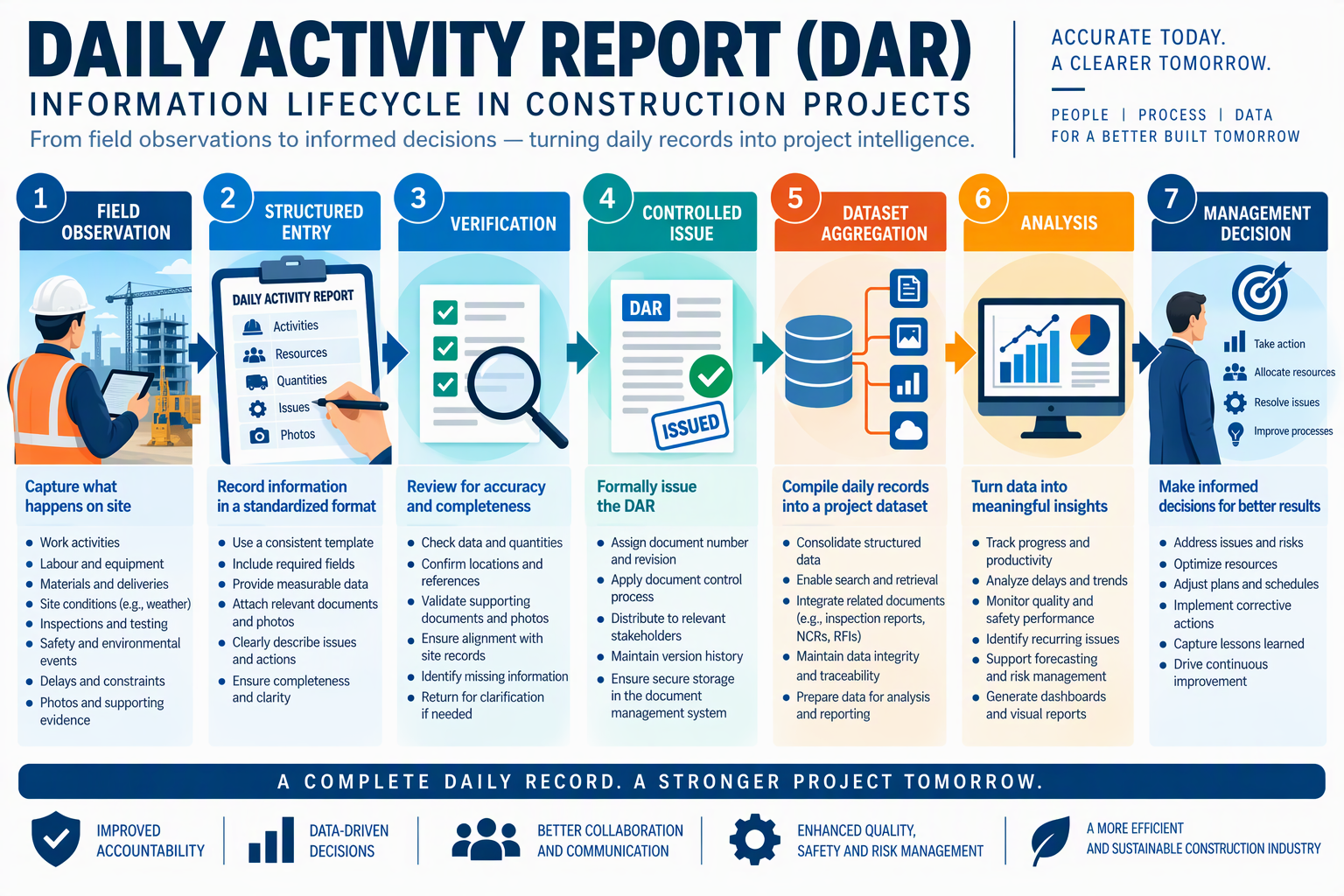
The proposed information lifecycle is: field observation, structured DAR entry, verification, controlled issue, dataset aggregation, analysis, and management decision. This approach aligns daily reporting with intelligent information systems [4], document-management practice [5], and reusable construction knowledge [6].
IX. DISCUSSION
The DCS responds to a practical gap between document compliance and information usefulness. A report may carry a valid number, revision, workflow, and approval yet omit measurable progress or the evidence needed to understand field events. The framework therefore gives the greatest combined weight to activities, quantities, manpower, equipment, quality, safety, and delays.
The framework also supports emerging analytics. Delay prediction requires consistent historical features [1]. Automated description of construction images requires contextual and task-specific information [2], [3]. Intelligent information and knowledge-management systems require structured, retrievable inputs [4], [6]. Electronic document-management platforms can preserve and distribute the record, but successful use still depends on governance, role clarity, and user knowledge [5].
Implementation should include reviewer calibration. A pilot sample of at least 20–30 reports should be independently scored by two reviewers. Differences should be discussed, and the scoring guide refined before full application. Inter-rater reliability may be measured using weighted Cohen’s kappa. The proposed category weights should also be validated through expert review or an analytic hierarchy process before being adopted as contractual acceptance criteria.
X. LIMITATIONS
This paper proposes and theoretically grounds the scoring framework but does not report fabricated case-study results. The source register previously examined demonstrates that document date and submission date can support timeliness analysis, but the underlying report PDFs were not all available for full content scoring at the time of drafting. Accordingly, no empirical mean DCS, category deficiency rate, or inter-rater reliability statistic is claimed. Future work should apply the matrix to the complete report population and publish anonymized aggregate findings.
XI. RECOMMENDATIONS
Projects should adopt one controlled DAR template; require location-specific and quantity-based activity records; relate manpower and equipment to work items; record the cause, duration, impact, and mitigation of delays; cross-reference inspections, tests, RFIs, NCRs, and instructions; require structured photograph metadata; assign owners and due dates to open actions; and monitor DCS, timeliness, and continuity through a dashboard. A provisional target of DCS ≥ 90 may be used for pilot improvement, but contractual thresholds should be validated before enforcement.
XII. CONCLUSION
DARs should be treated as controlled construction information assets rather than routine administrative submissions. The proposed fourteen-category DCS offers a repeatable method for distinguishing a formally submitted report from a comprehensive and traceable construction record. When combined with submission-lag and continuity metrics, it supports balanced evaluation of availability, punctuality, and technical content.
The central contribution is the transition from document-based daily reporting to data-oriented daily reporting. Standardized fields for progress, resources, assurance, delays, instructions, actions, and evidence allow individual reports to form a longitudinal dataset. This dataset can strengthen project control today and enable future applications in delay prediction, multimodal evidence analysis, intelligent information management, and organizational learning [1]–[6].
REFERENCES
[1] “The feasibility study of the application of big data to predict delay situations in construction projects with daily report data,” in IEEE Conference Proceedings, 2024, Art. no. 10625684, doi: 10.1109/ACCESSNETS.2024.10625684.
[2] “Enhancing daily reports: Application of multimodal GPT for image description generation in construction site quality assurance,” in IEEE Conference Proceedings, 2024, Art. no. 10769129.
[3] “Optimizing construction safety: Multimodal prompts for automated image descriptions in daily construction reports,” in Proc. 2025 IEEE Int. Conf., 2025, Art. no. 11386061.
[4] “Design and implementation of intelligent construction engineering information management system,” in IEEE Conference Proceedings, 2019, Art. no. 8858617.
[5] H. Fernando, T. Hewavitharana, A. Perera, et al., “Evaluation of electronic document management (EDM) systems for construction organizations,” in Proc. 2019 Moratuwa Eng. Res. Conf. (MERCon), Moratuwa, Sri Lanka, Jul. 2019, doi: 10.1109/MERCon.2019.8818768.
[6] “Knowledge management in construction quality management: Current state, challenges, and future directions,” IEEE Access, 2025, Art. no. 10922135.
[7] “A systematic review of the digital transformation of the building construction industry,” IEEE Access, 2024, Art. no. 10436076.
[8] D. Vararean-Cochisa and E.-L. Crisan, “The digital transformation of the construction industry: A review,” IIM Ranchi Journal of Management Studies, vol. 4, no. 1, pp. 3–16, 2025, doi: 10.1108/IRJMS-04-2024-0035.
[9] Royal Institution of Chartered Surveyors, “Digitalisation in construction report 2024,” London, U.K., Nov. 2024.
[10] P. Perera, S. Perera, X. Jin, M. Rashidi, S. Nanayakkara, G. Yazbek, and A. Yazbek, “Deep learning-enabled visual computing in construction: Application and digital technology integration,” Frontiers in Built Environment, vol. 11, 2025, doi: 10.3389/fbuil.2025.1655847.
[11] “Applications of multimodal large language models in construction industry,” Advanced Engineering Informatics, 2026.
[12] “Multimodal machine learning in the AEC industry: A lifecycle-aligned review of strategies, challenges, and informatics frameworks,” Advanced Engineering Informatics, 2026.
[13] D. G. Samontina, “The invisible backbone of every project: Why document controllers deserve a seat at the table,” LinkedIn, Oct. 22, 2026. [Online]. Available: LinkedIn article.
The complete PDF of this paper is available below:


