
- The country comparison spans 3.0 percentage points between Poland at 7.1% and Japan at 4.1%.
- Poland will remain 0.8 percentage point above the United States through specialised construction growth and rising housing permits.
- The United States will remain 0.4 percentage point above the United Kingdom as highway and nonresidential programs keep ready-mix volumes large.
- United Kingdom demand will remain 0.3 percentage point above the Netherlands through repair work and safety approvals for higher-risk buildings.
- The Netherlands will remain 0.8 percentage point above Germany on the back of rising housing permits and civil engineering turnover.
- Germany will remain 0.7 percentage point above Japan through a recovery in civil engineering orders.
- Japan will close the displayed range through steady public investment and maintenance of aging bridges and tunnels.
Comparable CAGRs create different entry conditions for additive suppliers, shaped by cement supply and public works budgets. Full report coverage includes North America, Latin America, Western Europe, Eastern Europe, East Asia, South Asia & Pacific, Middle East & Africa.
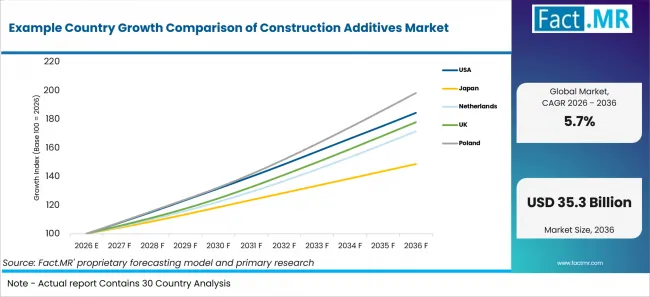
Example Country Growth Comparison Of Construction Additives Market | Source: Fact.MR
What supports Poland adoption?
7.1% CAGR, supported by specialised construction growth and rising housing permits.
Statistics Poland reported that construction and assembly production rose 3.9% year on year in May 2026 [5]. Specialised construction activities grew 10.8% in the same month, and that division covers the installation and finishing trades where waterproofing and repair mortars are applied [5]. The number of dwellings granted permits in January to April 2026 was 15.8% higher than a year earlier [6].
How is the United States scaling demand?
6.3% CAGR, driven by highway work and large public construction budgets.
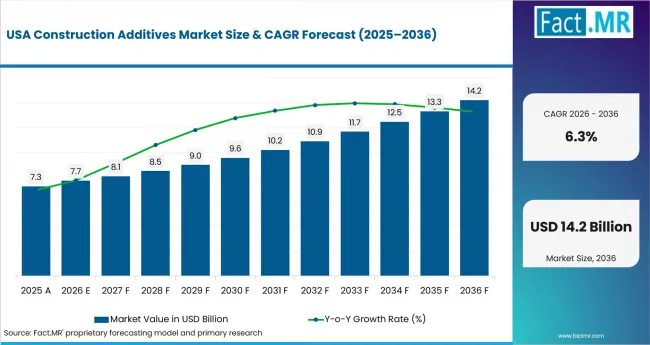
Construction Additives Market Country Value Analysis | Source: Fact.MR
The U.S. Census Bureau reported that public construction spending ran at a seasonally adjusted annual rate of USD 543.4 billion in July 2026 [4]. Highway construction accounted for USD 150.3 billion of that rate, and bridge and pavement concrete relies on air-entraining agents for freeze-thaw and deicing salt exposure [4]. State transportation departments write these requirements into their concrete specifications, which favors suppliers on approved product lists.
What supports the United Kingdom’s growth?
5.9% CAGR, backed by repair work and higher-risk building approvals.
The Office for National Statistics estimated that construction output grew 0.3% in the second quarter of 2026, with new work up 0.4% and repair and maintenance up 0.2% [7]. The Building Safety Regulator approved 46 applications for new higher-risk buildings and conversions between June and August 2026, covering 9,362 residential units [8]. Contractors on these schemes need waterproofing and repair systems backed by test evidence that clears regulator review.
How is the Netherlands developing demand?
5.6% CAGR, supported by rising housing permits and civil engineering turnover.
Statistics Netherlands reported that permits were issued for 23.5 thousand new-build homes in the first quarter of 2026, which is 4.7 thousand more than a year earlier [9]. Construction turnover rose 5.2% in the second quarter of 2026, and civil engineering firms posted a 5.9% gain [10]. Soft, water-saturated ground means Dutch basement and tunnel concrete needs integral waterproofing.
What is supporting Germany’s adoption?
4.8% CAGR, driven by recovering civil engineering orders.
German construction orders are improving after a weak housing cycle. Destatis reported that real order intake in main construction was 11.3% higher in June 2026 than a year earlier [11]. Civil engineering orders rose 9.3% in the second quarter of 2026 compared with the first quarter [11]. Rail and bridge projects use concrete with strict durability classes, which will support plasticizer and retarder demand.
How does Japan perform?
4.1% CAGR, led by steady construction investment and infrastructure maintenance.
Japan’s Ministry of Land, Infrastructure, Transport and Tourism projected fiscal 2026 construction investment at JPY 81.47 trillion [12]. The ministry expects a 2.9% increase over fiscal 2025 [12]. Public works increasingly go to maintaining bridges, tunnels and seawalls from the high-growth decades. Aging structures need repair mortars, corrosion inhibitors and surface waterproofing.


