
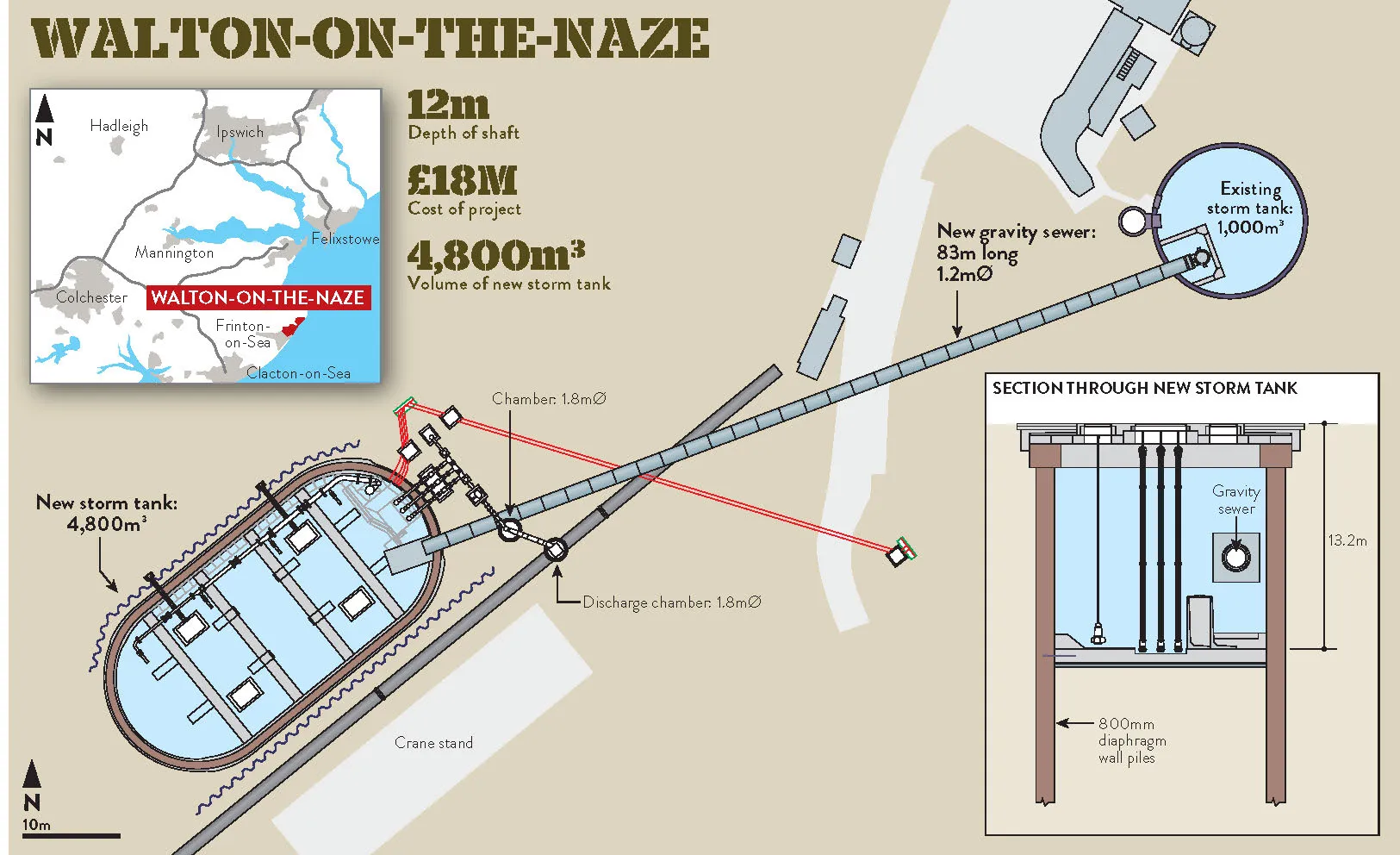
In Walton-on-the-Naze in Essex, a 1.2m-diameter TBM pipe-jacked tunnel will connect new and existing storm overflow tanks to help preserve the water quality of the sea for local and visiting bathers.
Both Frinton and Walton-on-the Naze Beaches in Essex have Blue Flag status. Awarded by charity Keep Britain Tidy, Blue Flag beaches are assessed on bathing water quality, environmental management, cleanliness, environmental information, safety and facilities.
However, Blue Flag status doesn’t necessarily mean that wastewater never makes its way into the waves. A combined sewer overflow at Walton-on-the-Naze, close to both beaches, sometimes discharges into the sea. According to WaterWatch, there had been 85 spills lasting a total of 5.2 hours in 2026 to the end of October.
The problem is that an existing storm tank at the Walton-on-the-Naze terminal pumping station, which fills up when heavy rainfall causes flow rates to exceed the pumping station’s capacity, is not big enough. Factoring in population growth and more frequent, higher intensity rainfall events due to climate change, this issue was only set to get worse.
To reduce storm overflows into the sea and build in resilience for the future, Anglian Water is investing £18M in a new 4,800m3 storm tank which will be connected to the existing 1,000m3 tank by an 83m-long, 1.2m-diameter gravity sewer.
Once in operation, stormwater from the new tank will be returned to the existing network using three submersible pumps. An intelligent real-time control system will govern the storage and return cycles in response to stormwater conditions, linked into existing control systems at the pumping station.
Principle contractor Barhale is due to start constructing the connecting sewer in early December 2026, by pipe jacking. A 1200mm-diameter earth pressure balance tunnel boring machine (TBM) is to cut through the clay ground between the new and existing storm tank, with 2.5m-long concrete pipe sections jacked in behind it.
“We have a tunnelling team that travels around with the machine, experts in this type of work,” says Barhale senior project manager Dan Ledger. “It’s quite a simple drive for them, with plenty of space for the launch, a crane on site and great access. The more challenging bit is at the other end.” The TBM must break through into the existing stormwater tank, which must remain operational throughout the project.
There are programme constraints too. The project must meet a May 2027 obligation date to reduce combined stormwater overflows, set by regulator Ofwat under the current asset management period (AMP).
Delivered through its @One Alliance, the project at Walton-on-the-Naze is part of a wider programme of works which will see Anglian Water invest over £2bn on environmental improvements between 2025 and 2030.
Anglian Water’s record on bathing water is already good, says Adam Worley, the company’s catchment to coast manager: “At the end of the last bathing water season, we had 96.3% of our bathing waters in the good or excellent category which is the highest proportion for any of the water company areas in England. This is part of a continued piece to make sure we maintain those good and excellent bathing waters.”
The bathing season currently runs from 15 May to 30 September in England and Wales. However, the regulator may look to extend that, says Worley – another reason to add resilience to the system.
Physical constraints
During the optioneering phase, the project team – which is made up from members of the @One Alliance comprising Anglian Water, Balfour Beatty, Barhale, Binnies, Mott MacDonald Bentley, MWH Treatment, Skanska and Sweco – looked at whether the new underground storage tank could be built on Anglian Water-owned land around the pumping station and existing storm tank.
However, the site was previously a treatment works facility and ground investigations revealed that there were too many below-ground structures.
The solution was to use a nearby strip of land owned by Tendring District Council which is used as an overflow car park. Shaped a little like an orange segment, the area is bounded along its curved side by a flood embankment which holds back water from the tidal Walton Mere and on its other side by North Street.
“We have had really good buy-in from the local authority,” says Worley. “There could have been resistance, given it’s a car park in a tourist area but they want their bathing waters to be as good as they can be, and they see the benefit of this project.”
The width available for the tank beneath the car park is further constrained by the presence of a 1050mm-diameter sewer which passes through the land, around 3m from the nearest side of the new tank. Barhale has protected the sewer and the flood embankment from movement by installing a wall of sheet piles either side of the new tank position.
“Given the size of the sewer, and the flow rates, it would have been hard to remediate it in place,” says Ledger, adding that the sheet piles also allowed the ground level to be reduced to provide depth for the diaphragm wall capping beam and cover slab. The car park will be reinstated above the tank once it is complete.
A conventional approach for building the tank would have been to construct a circular structure, using a secant piled wall. However, an added complication here is the presence of ground water. The site investigation determined that the ground here is the London Group, below made ground, with a thin layer of interbedded silty sand at approximately 19m at the new tank location.
“There was a high risk we could have gone down to that level. That was something we did not feel we could adequately manage as a risk in terms of dewatering and managing the excavation,” says Ledger.
Large-volume dewatering can cause knock-on effects such as settlement of nearby structures or buildings and requires permits from the Environmental Agency, he explains.
Specialist contractor Bachy Soletanche came up with an alternative solution. Rather than a 19m-diameter circular shaft with an internal finished depth of 17m, Bachy Soletanche suggested a pill-shaped shaft, with internal dimensions of 37m long, 17m across at its widest point and 12m deep.
Between January and October 2026, Bachy Soletanche constructed the walls of the shaft, which has permanent reinforced concrete bracing at its upper level, using diaphragm walls. It had also constructed permanent reinforced concrete cross-bracing beams at the upper level of the shaft.
Additionally, Bachy Soletanche’s design incorporates eight barrette piles beneath the base of the tank which reduce forces in the base, allowing it to be thinner, saving on concrete and embodied carbon. Bachy Soletanche constructed the piles using its diaphragm-
wall equipment, 31m deep from the surface and concreted up to the point where they will tie into the tank base slab at 12m depth.
Diaphragm-wall methodology is unusual for this type of project, says Ledger. “The D-wall construction is something we have never done before and that’s been fascinating, end to end,” he says.
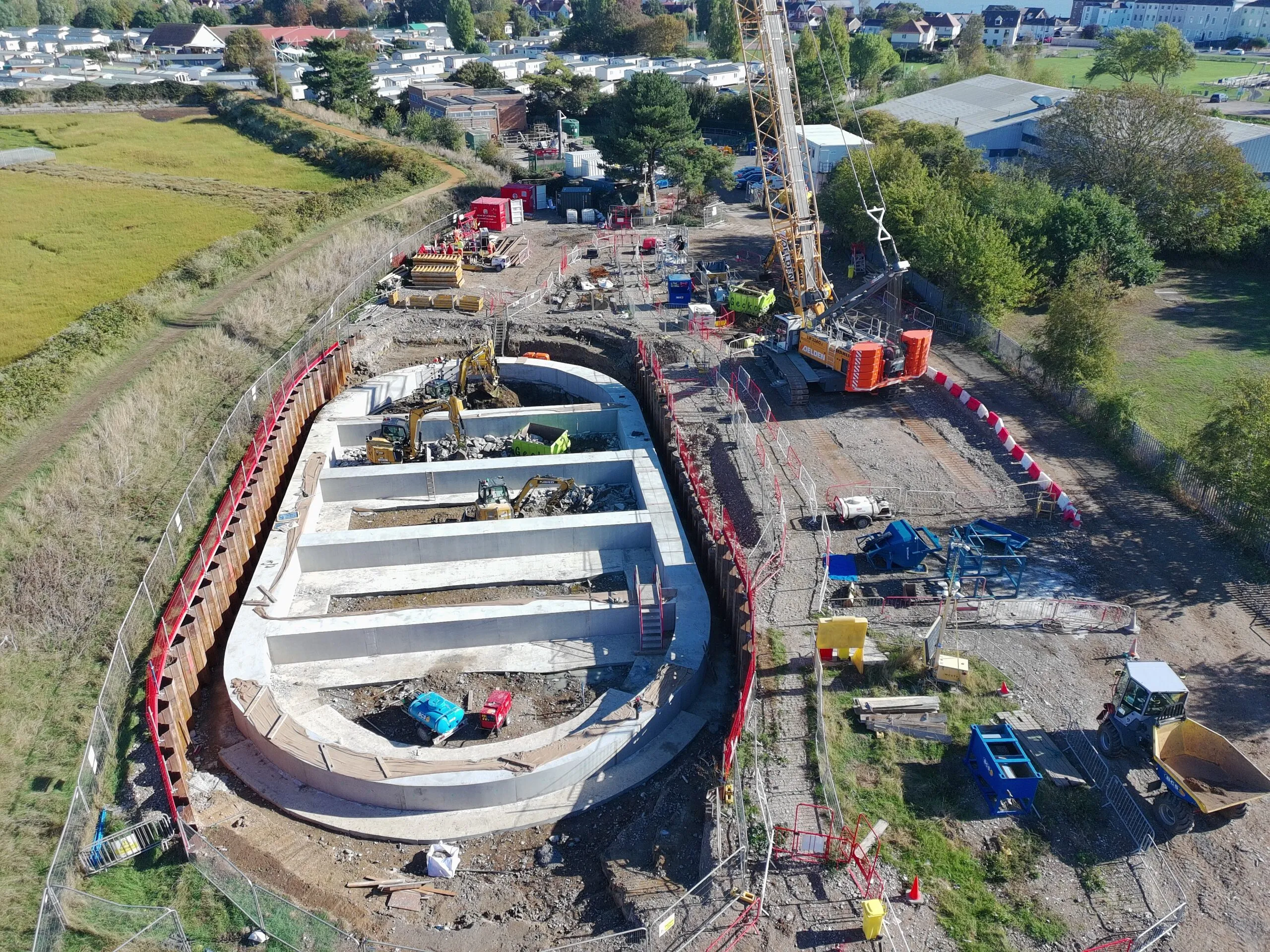
A pill-shaped shaft, with internal dimensions of 37m long, 17m across at its widest point and 12m deep is being constructed
The tunnel drive
The tunnel will be constructed at around 8m below ground level, running slightly uphill so there is a fall of around 200mm between the existing and new stormwater tanks.
Barhale does not expect any challenges in the ground for the TBM: “It is good clay as per the boreholes. We have viewed the sides of the diaphragm wall and witnessed all the material coming out of that; it is great ground for tunnelling,” says Legder, who expects the drive to last less than the two weeks programmed.
By early November 2026, Bachy Soletanche had completed the diaphragm wall construction and excavated the shaft to around half its depth. This will provide a platform for the TBM’s launch.
At the time of writing, Barhale was about to start constructing a reinforced concrete block or head wall, which will include a gland, or seal, for the TBM to launch through. A steel thrust frame – which the hydraulic jacks push against when driving the pipe sections into the ground – was waiting at the surface, to be lifted in and its base concreted into place.
Once it has completed its drive, the Iseki Unclemole TCC TBM – named Diggerblaster by children from a neighbouring primary school – will break through into the existing storm tank and be lifted out by crane.
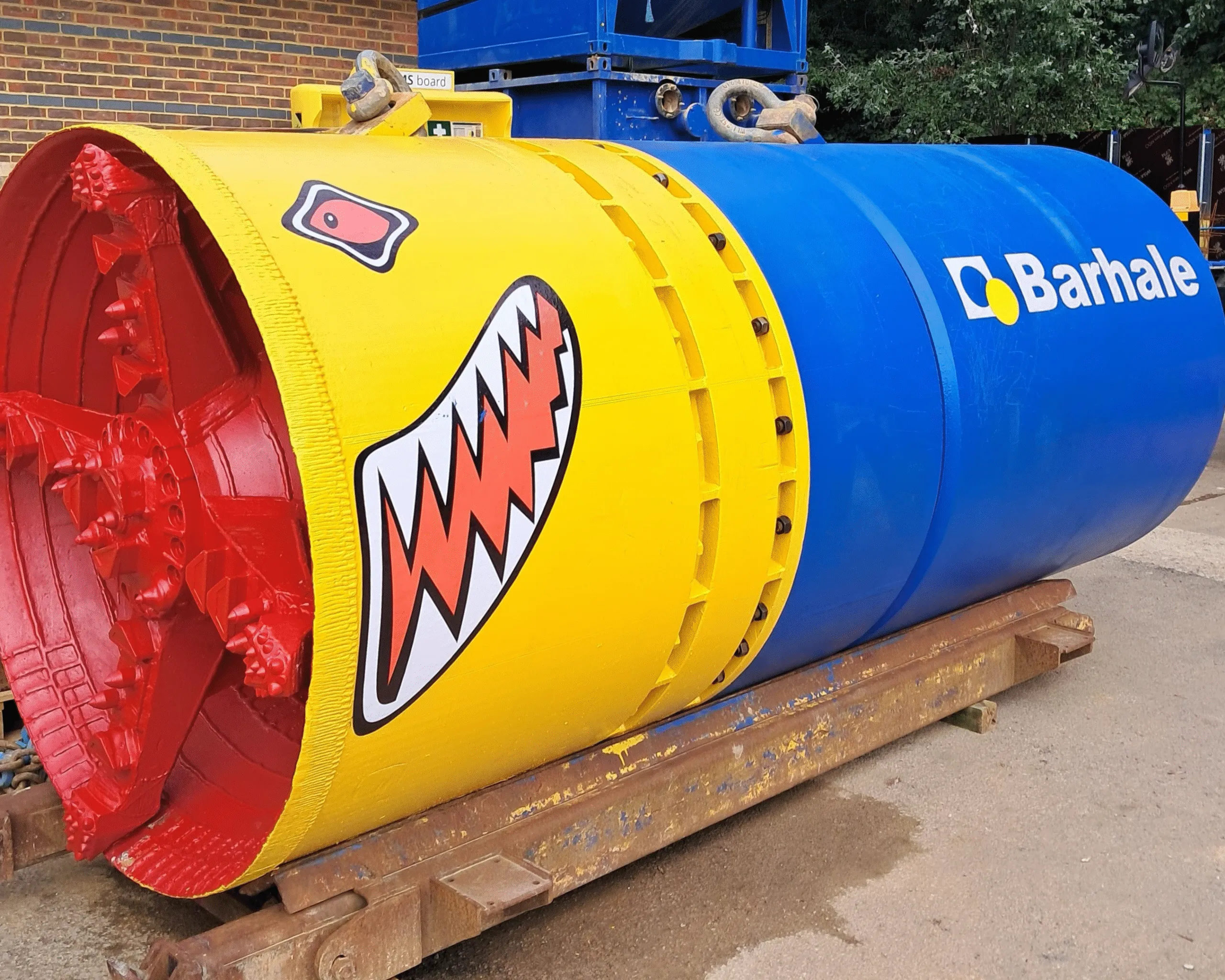
The Iseki Unclemole TCC TBM, named Diggerblaster
To ensure a dry environment for the breakthrough, Barhale is deploying a limpet dam – a steel, three-sided box structure which fits against the wall of the shaft. This is another first for the company, says Ledger. More conventionally used in harbour works, subcontractor Robert Nicholas reports that limpet dams are being used more frequently for this type of project, says Ledger.
At the end of October 2026, Robert Nicholas was installing the steel limpet dam in sections which are bolted onto the wall of the tank, with a grout seal between the lowest section and the base. This will remove 100m3 of storage from the tank, with that lost storage volume being provided by making adjustments to the system.
Ledger explains that by tweaking the weir heights on the inlet structure through the pumping station, more storage can be gained in the existing system. “That creates capacity by raising the height of the weir without backing the sewers up. That has been assessed through hydraulic model. It has no impact but keeps the volume as large as you can get it to prevent spills.” This removes the need to gain Environmental Agency approval for reducing storage volumes.
If all goes to plan, the tunnelling works will be completed well before the Christmas 2026 break. “This is a key bit for us that we always really wanted to get done before Christmas,” says Ledger. “That allows us to get back into the storm tank, complete the excavation and start working through the next phase. A critical part of the programme is getting that tank operational for the obligation date,” says Ledger.
Construction of the tank’s permanent base will follow the full excavation. Barhale must then install the pumps, external pipework for the pump return, and a 90° pipe in the existing storm tank to create a new weir, as well as the motor control centre (MCC) and electrical works. The car park will be reinstated after the cover slab to the tank has been cast, with final completion scheduled for November 2027.
With both the diaphragm wall methodology and the limpet dam new to Barhale, Ledger is sharing information about them with colleagues working on other water projects. “We have a very similar project up north, so we are feeding into that,” he says. “A circular shaft would potentially be cheaper and more efficient, if the ground and available land allow that. The limpet dam has added a massive amount of benefit so that’s definitely something we would use in the future.”


