
Key Takeaways
- Non-CS engineers can build careers in data science and AI.
- Programming, statistics, and machine learning skills matter.
- Practical projects help prove your technical abilities.
- Credential evaluation explains how a foreign degree compares with a US degree.
- H-1B eligibility depends on the degree and job requirements.
- Expert opinion letters can explain the link between your education and proposed role.
Computer science isn’t the only door into data science and AI. Mechanical, electrical, civil, chemical and electronics graduates get into these fields too. Who gets hired has more to do with skills and background than with the name on the degree.
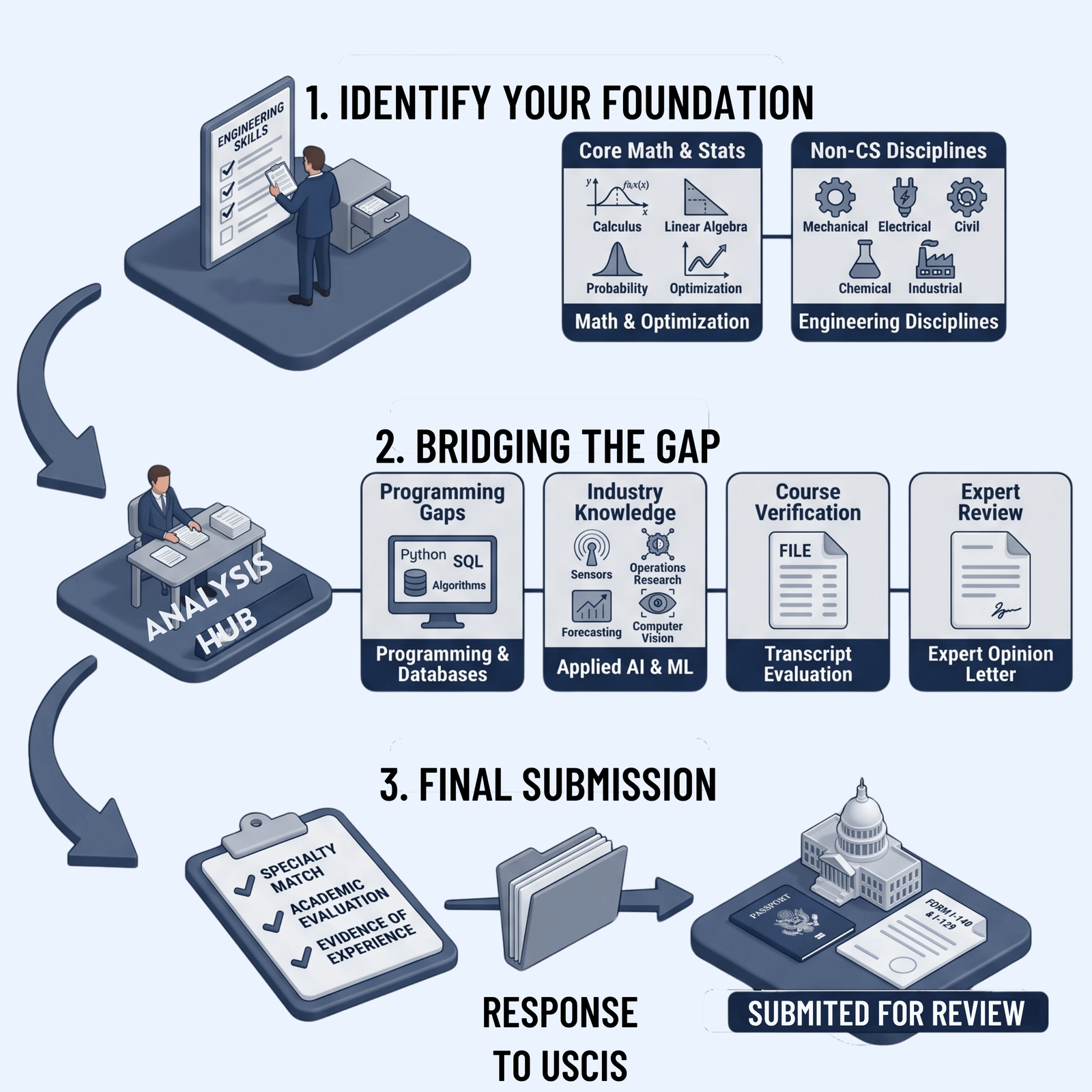
Think about what your engineering course actually gave you: math, statistics, a habit of breaking problems down, some modeling. All of that helps when you’re working with data. What it probably didn’t give you is the programming and CS depth that data science and AI employers look for. That gap is the part you’ll have to fill yourself.
The US Bureau of Labor Statistics lists engineering among the degree fields tied to data science. It also says programming, math, statistics and computer skills matter for the job. So your first task is simple. Find the roles that fit what you already know, then learn what those roles need on top.
💡 Next Step: When leveraging this interdisciplinary transition for US immigration, proving your unique background qualifies for a National Interest Waiver requires authoritative validation. Hire our specialized agency to Get Professional EB-2 NIW Expert Letter Service and secure the independent industry evidence needed to strengthen your petition.
Can A Non-CS Engineering Degree Lead To A Data Science Career?
Yes, an engineering degree gives you a real base for data science, machine learning and AI roles, especially if your course covered calculus, linear algebra, probability, statistics, numerical methods, optimization, programming or applied modeling. The BLS describes a data scientist’s work as collecting, cleaning, analyzing and visualizing data, building and validating algorithms and models, and turning the findings into recommendations.
But the degree title alone is rarely enough. A mechanical engineering graduate who never studied programming, statistical modeling, or machine learning may have strong quantitative training without yet having the specific technical preparation for a data scientist position. Conversely, an electrical or industrial engineering graduate with substantial coursework in signal processing, control systems, optimization, simulation, or statistical quality analysis may have a much closer educational connection to particular data roles.
The useful question is not “Is engineering accepted in data science?” It is: Which parts of this engineering education align with the duties of this particular job?
Which Engineering Subjects Are Relevant To AI And Machine Learning?
Data science and AI roles draw on several overlapping skill areas. O*NET identifies mathematics, computer use, data processing, programming, model development, and analytical communication among the core activities and requirements for data scientists. Engineering programs often address some of these areas, though the depth and emphasis differ by discipline.
| Engineering Discipline | Commonly Relevant Foundations | Typical Gaps To Address |
| Mechanical engineering | Calculus, differential equations, dynamics, finite element analysis, simulation, control systems, optimization | Machine learning, database skills, software engineering practices |
| Electrical engineering | Linear algebra, signals and systems, probability, digital signal processing, control theory, embedded programming | Large-scale data engineering, statistical inference, ML deployment |
| Civil engineering | Statistics, numerical methods, structural modeling, geospatial analysis, risk and reliability analysis | Programming depth, ML methods, cloud and data-pipeline tools |
| Chemical engineering | Process modeling, thermodynamics, transport phenomena, optimization, process control, numerical computation | Modern ML frameworks, software development, data visualization |
| Industrial engineering | Operations research, optimization, simulation, quality control, statistics, production analytics | Advanced machine learning, software architecture, distributed computing |
These are broad patterns, not rules. Curricula vary by university, country, program level, and individual course selection. A transcript is therefore more informative than a degree title because it shows whether the graduate actually completed the relevant mathematics, computing, and modeling courses.
Why Are Engineering Disciplines Not Interchangeable?
A mechanical engineering degree fits well with predictive maintenance, sensor-data analysis, simulation, robotics and manufacturing analytics. Electrical engineering fits computer vision, signal processing, embedded AI, control systems and hardware-related machine learning. Chemical engineers can work on process optimization, materials informatics and industrial modeling. Industrial engineering connects directly to operations research, forecasting, quality analytics and supply-chain modeling.
Civil engineering has its own openings too, like infrastructure analytics, geospatial modeling, structural-health monitoring and risk analysis. If the role is built around statistical learning or software-based AI systems, though, a civil engineer will probably need more extra preparation.
The difference shows up in job applications as well as in credential documentation. You should tie your background to the actual work. An electrical engineer going for a computer-vision role can point to signal processing, image-related coursework, programming and relevant projects. A civil engineer applying for a general data scientist role will likely have to show stronger proof of statistical modeling and programming.
What Employers Look For Beyond The Degree Title?
The BLS says data scientists usually need at least a bachelor’s degree, and the common fields are math, statistics, computer science, business and engineering. It also stresses a lot of study in math and statistics, programming for data work, databases and analysis software. O*NET paints the same picture. Its list of tasks includes working with large datasets, testing and checking models, writing code, comparing models using performance numbers and presenting results to the people who rely on them.
When employers look at a candidate, they usually check five things:
- Coursework: Calculus, linear algebra, probability, statistics, numerical methods, optimization, algorithms, databases and machine learning.
- Programming: Python, R, SQL or similar tools, plus some comfort with the libraries and steps used in data analysis.
- Projects: A final-year project, research, an internship, a competition or a real work project where you used real data and built a model.
- Industry knowledge: Manufacturing, energy, healthcare, finance, logistics, telecom or any other field where your engineering background gives you an edge.
- Communication: Being able to explain a model’s assumptions, its limits and what it means for the business to people who aren’t technical.
A mechanical engineer who has built a predictive-maintenance model from equipment sensor data, for example, can show a clearer relationship to data science than someone who merely lists “engineering degree” on a resume. The project demonstrates data cleaning, feature selection, model validation, and communication of results activities that correspond closely to the duties BLS and O*NET describe for data scientists.
Data Analyst, Data Scientist, And Machine Learning Engineer
These three jobs overlap a lot, but they aren’t the same thing.
- A data analyst cleans data, queries it, builds charts and explains what it means so the business can answer a specific question. Your engineering background helps here, especially if the data comes from operations, manufacturing, quality checks, logistics or infrastructure.
- A data scientist handles the whole modeling process. They find the right data, prepare it, build and test models, make sense of the results and suggest what to do next. The BLS describes this work as using algorithms, machine learning and data visualization to give the business clear recommendations.
- A machine learning engineer cares mostly about getting models to work in real systems. That means turning a model into reliable software, connecting it to data pipelines and keeping it running well as usage grows. Employers expect stronger software skills here than they do from a regular analyst.
An engineering degree can help you in any of these jobs, but what you have to show is different for each. For an analyst job, good SQL, visualization skills and knowledge of your industry can be enough. For a machine learning engineer job, you’ll need to prove you can code, build software, work with the cloud and deploy models, along with the math background.
How A Foreign Engineering Degree Is Understood In The US
For readers educated outside the United States, the central issue is often how a foreign qualification compares with a US degree. A credential evaluation translates the foreign qualification into a US educational context typically identifying the country, institution, program, level of study, duration, and US degree equivalency.
A general academic equivalency evaluation can establish that a foreign qualification is comparable to a US bachelor’s degree, for example. A course-by-course evaluation goes further by listing individual subjects, credit values, grades, and sometimes a US GPA calculation. For an engineer moving toward data science or AI, a course-by-course report can be especially useful because it documents the mathematics, statistics, computing, and technical courses that support the claimed relevance.
Document Evaluation LLC offers academic equivalency evaluations from $119 and course-by-course evaluations from $419, with pricing varying by turnaround time.
An evaluation does not create skills that are absent from the record and it does not guarantee that an employer, university, or immigration authority will reach a particular conclusion. Its value is to present the foreign education clearly and accurately in a US framework.
When An Expert Opinion Letter May Help?
An expert opinion letter may be relevant when the relationship between an engineering education and a proposed data science or AI role is not obvious from the degree title.
For example, a reviewer with relevant expertise may explain how specific coursework in linear algebra, probability, numerical optimization, and programming relates to machine learning duties or how professional experience in industrial analytics supplements an engineering degree.
This is most useful when the letter is based on the individual’s actual documents: transcripts, syllabi, project descriptions, employment records, publications, technical work products, and the proposed job duties. A generic letter that merely asserts that “engineering is related to data science” adds little. Document Evaluation LLC describes its expert opinion letters as independent assessments based on the client’s background and supporting documents, supported by a network of more than 140 field experts across more than 50 fields.
We also offer RFE-response support beginning at $549 for certain H-1B, EB-2, EB-3, and I-485 matters, with pricing depending on the case type and turnaround time. Such support should address the specific evidentiary concern raised by USCIS rather than submit unrelated documents.
SUGGESTED: Data scientists and AI engineers can use EB-2 NIW expert letter
Immigration Documentation: H-1B And EB-2 Context
For immigration purposes, the analysis is more specific than a general career discussion. USCIS states that an H-1B specialty occupation requires the theoretical and practical application of highly specialized knowledge and, at minimum, a bachelor’s or higher degree in a directly related specific specialty or its equivalent. USCIS defines “directly related” as a logical connection between the required degree, or its equivalent, and the duties of the position.
That means an engineering degree may support an H-1B petition for a data-focused role only when the record shows a logical connection between the education, or equivalent experience, and the actual duties. USCIS also recognizes alternatives to holding the required US degree, including a foreign-degree equivalent or a combination of education, specialized training, and progressively responsible experience.
For EB-2, USCIS distinguishes advanced-degree eligibility from exceptional ability. An advanced-degree professional generally needs a US advanced degree or foreign equivalent, or a US bachelor’s degree or foreign equivalent plus at least five years of progressive experience in the specialty. USCIS states that qualifying post-bachelor’s experience must relate to the degree field or the proposed endeavor.
EB-2 NIW is separate from basic EB-2 eligibility. A national interest waiver requires USCIS to consider whether the proposed endeavor has substantial merit and national importance, whether the person is well positioned to advance it, and whether waiving the job-offer and labor-certification requirements benefits the United States. USCIS considers the totality of the evidence and states that no single factor establishes eligibility. To build a compelling case that connects your engineering background to US national interests, it is highly beneficial to understand how Data scientists and AI engineers can use EB-2 NIW expert letter evaluations to bridge this technical gap. An engineer moving into AI may therefore need to document more than a degree.
An engineer moving into AI may therefore need to document more than a degree. Relevant evidence can include detailed course descriptions, technical projects, software or model-development work, employer letters explaining specific responsibilities, professional recognition, and evidence connecting the person’s background to the proposed role or endeavor. None of these items alone guarantees an immigration outcome.
Practical Next Steps For Engineers
If you have a non-CS engineering degree and are considering data science or AI work, start by mapping your record to the target role.
- Check your transcript for math and computer courses: Look for statistics, linear algebra, programming, optimization, simulation, machine learning, databases and numerical methods.
- List the work you have actually done: Include final-year projects, research, internships, publications, tools you built for your team, dashboards, prediction models and anything that ran in a live system.
- Fill the big gaps on purpose: If your degree had no statistics or programming, a short course, a certificate or a few well-documented projects can cover it.
- Tailor application materials to the job description: Explain how specific courses and projects relate to the employer’s stated duties.
- Obtain a credential evaluation if your degree is foreign: A course-by-course evaluation is often more useful than a general equivalency when the relevance depends on individual subjects.
- Consider an expert opinion letter only when the connection needs expert explanation: It is most valuable when your transcript, work history, and proposed role require a careful technical bridge.
Official Sources:
Frequently Asked Questions
Can a mechanical engineer become a data scientist?
↓
Yes, if you can show the analytical, statistics, programming and modeling skills the job needs. Mechanical engineering usually covers math, simulation, dynamics and optimization, but you’ll still need to prove your machine learning, statistics and programming through courses, projects or work experience. The BLS lists engineering among the common degree fields for data scientists.
Is a computer science degree mandatory for AI jobs?
↓
No! The BLS names math, statistics, computer science, business and engineering as common fields for data scientists, and some employers want or prefer a graduate degree. That said, a specific AI or machine learning engineering job may still ask for hands-on programming, software or model-building experience, whatever your degree is in.
Can an electrical engineering graduate work in machine learning?
↓
Yes. Electrical engineering teaches linear algebra, probability, signals and systems, control theory and programming, all of which are useful for machine learning. How strong your case is depends on your own transcript, your projects and the specific role.
Does an engineering degree automatically qualify someone for an H-1B data science job?
↓
No. USCIS requires the job to be a specialty occupation. The applicant must also hold a US degree, a foreign equivalent, a license where one applies, or a mix of education, training and experience that qualifies in that specialty. The degree also has to connect logically to the job’s duties.
Does a foreign engineering degree need credential evaluation in the United States?
↓
Not always for getting a job. You usually need one when a US employer, university, licensing body or immigration filing asks for proof that your degree matches a US one. For H-1B, USCIS accepts a foreign degree that is equivalent to the required US degree.
What is the difference between a general and course-by-course evaluation?
↓
A general evaluation tells you what your overall qualification is equal to in the US A course-by-course evaluation lists each subject, its credits, your grades and sometimes your GPA. That makes it more useful when your specific technical courses matter.
When is an expert opinion letter useful for an engineer?
↓
It helps when your degree title doesn’t clearly show a link to data science, AI or the specialty occupation being proposed. A good letter looks at your actual coursework, projects, experience and the job’s duties, and doesn’t just make a general statement about engineering.
Can work experience substitute for a computer science degree?
↓
Sometimes. For H-1B, USCIS accepts a combination of education, specialized training and progressively responsible experience that equals the required US degree, along with recognition of your expertise in directly related jobs. For EB-2 advanced-degree eligibility, a US bachelor’s degree or foreign equivalent plus five years of progressive experience in the specialty can be treated as equal to a master’s degree, as long as USCIS requirements are met.

Explore EB-2 NIW rules, evidence strategies, and publication alternatives:
- What Is the EB-2 NIW Visa? The Complete Guide
Demystifies the National Interest Waiver pathway, explaining how advanced degree professionals and individuals with exceptional ability can bypass employer sponsorship and the lengthy PERM process to secure a U.S. Green Card. - How to Strengthen a Weak EB-2 NIW Evidence Profile
Outlines actionable strategies to reinforce your self-petition before filing. Details how to secure authoritative expert letters, document niche industry impact, and build a compelling case around your proposed endeavor to overcome USCIS scrutiny. - How to Secure an EB-2 NIW Without Publications
Explains how industry practitioners, engineers, and entrepreneurs can win USCIS approval without a traditional academic background by leveraging patents, commercial success, and real-world project implementation to prove national importance.


