
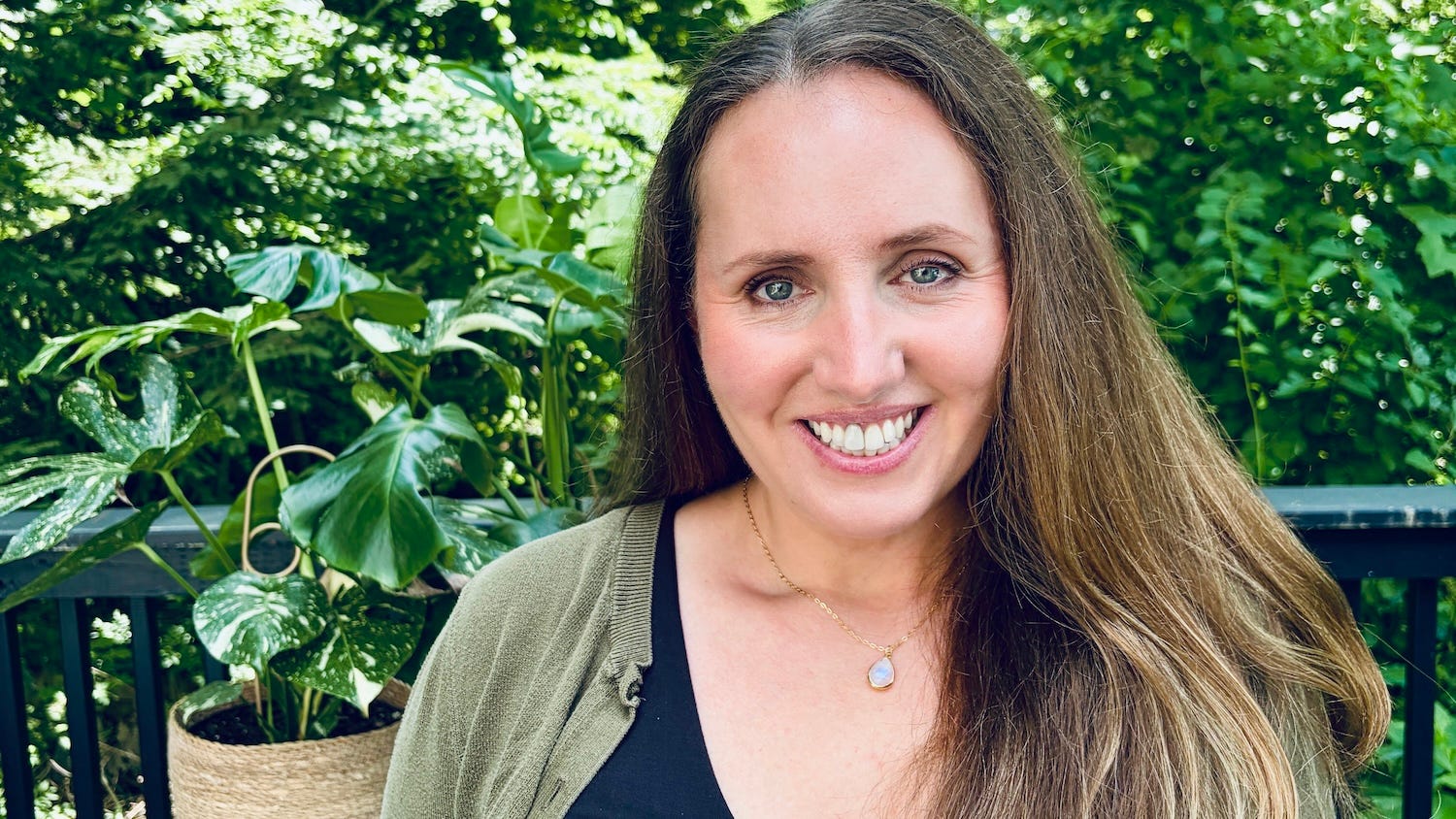
Sara Haupt is a civil and environmental engineer, a mother, and a Cranston resident running as a Democrat for City Council in Ward 2. She holds engineering degrees from the University of Washington and the University of Rhode Island, and lives in Cranston with her husband, Chris, and their son, Vincent. Haupt will appear on the ballot in the September 9 primary. She is running on a platform of increasing fiscal oversight, strong public schools, safer streets, and common-sense problem-solving at City Hall.
We met at the Seven Stars Bakery on Reservoir Avenue in Cranston to discuss her campaign. The transcript has been edited for clarity.
Steve Ahlquist: Can you give me a sense of who you are and what you do?
Sara Haupt: I’m a registered, professional civil engineer. I’ve worked in the civil engineering field for the last 14 years. One of the things I like about civil engineering is that it’s literally engineering for civilization. The whole point of it is to help your community. I’m very focused on the environment. I do a lot of environmental permitting and follow projects through construction, making sure we’re building and doing things in a way that protects the environment and complies with all the different regulations. A lot of people say that environmental regulations kill jobs, but that’s not been my experience. It’s created a lot of work for me, and it’s important.
I’ve lived a lot of places. I was born in Framingham, Massachusetts, but my family’s from Iowa, mostly, so we moved back to Iowa, then out to Washington State. I lived in Spokane, Washington before starting school in Seattle at the University of Washington, and I lived in Seattle for about seven years before moving to Rhode Island.
Steve Ahlquist: So bi-coastal, really.
Sara Haupt: Yes. I’ve lived a lot of places. I think I bring a different perspective and can do things a little differently than they are traditionally done here in Rhode Island. When I graduated from the University of Washington, my parents had already moved here to Rhode Island. So I followed them out. I lived in Providence for a while, and then I met my husband, Chris. We lived in Woodsocket together for several years, and then in 2020, we decided to get married – so I had a COVID wedding where I had planned a whole big wedding that I eventually had to cancel and pare down considerably.
But we still ended up getting married.
Steve Ahlquist: Getting married with an online preacher or something?
Sara Haupt: We were only allowed to have 10 people. One of the people was the officiant of our wedding. And then very close family. We got married in June of 2020 and had a reception in my parents’ backyard in Cranston. My parents were moving back to Iowa to help take care of my grandparents, so we bought my parents’ house on Shirley Boulevard.
Steve Ahlquist: What brought your parents out to Rhode Island in the first place? What was interesting about Rhode Island that made them come from Seattle?
Sara Haupt: My dad was a metallurgical engineer. He got a job working for Tiffany’s. He’s had a couple different jobs in New England as a metallurgical engineer since then.
Steve Ahlquist: I exist mostly because of the jewelry industry in Rhode Island. My dad’s family came from Sweden. And my mother’s family came from Quebec through Woonsocket. They met, as young people, at a factory in Warwick. You were brought here by some of the same currents, in a sense.
Sara Haupt: The perspective of jewelry manufacturing in Rhode Island is coming full circle. A lot of projects I’ve worked on in Rhode Island are cleaning up former jewelry sites.
Steve Ahlquist: Yes, that is 100%. The Mashapaug Pond in Providence is a mess. They gave up, put a fence around it, and said, “Don’t touch.”
Sara Haupt: People are starting to realize there are ways to do industry that don’t pollute the environment. I know Alex and Ani’s not around anymore, but I think that’s a good company to do it the right way.
Steve Ahlquist: My dad remembers working at a place where they printed and stamped things. He was a designer, so he would do these skull rings. He remembers stamping them out nd they would take the discarded parts that weren’t stamped out, and they would literally frisbee it out the window into the river. And there was no… sense whatsoever that this was going to be a problem.
Sara Haupt: Right, people didn’t know.
Steve Ahlquist: Or didn’t care. Engineering runs in your family then, because your dad was an engineer, you’re an engineer…
Sara Haupt: Different kinds of engineers, but that is part of why I became an engineer: my dad was an engineer.
Steve Ahlquist: What does your husband do?
Sara Haupt: My husband is a regional manager for a hotel chain.
Steve Ahlquist: That must be really nice for traveling.
Sara Haupt: Yes, but we don’t take advantage of it, really. We really should. It’s interesting to compare our jobs, because he has some interesting stories about things that happen in hotels, but I don’t have nearly as dramatic stories in engineering.
Steve Ahlquist: Civil engineering doesn’t sound as potentially sordid and exciting. I hope I’m not coming across as insulting to anyone.
Do you have any kids?
Sara Haupt: I have one, Vincent, three years old. I had to do two rounds of IVF to have Vincent. I’ve done two rounds since that weren’t successful. So I think we’re done with IVF, sadly.
Steve Ahlquist: That’s awesome. Three is the age they’re finally acting out and finding themselves. You can really start to see the adult person they will be.
Sara Haupt: In recent months, Vince has turned the corner where he’s a lot more aware of how he impacts other people, and he’s a lot more interested in playing with other kids.
Steve Ahlquist: My grandkids are two and four. Just fabulous.
Sara Haupt: Vince is very excited about turning four. He keeps reminding everybody, I’m going to be four on my next birthday.
Steve Ahlquist: With all that, and it sounds great, why would you want to run for city council? What makes you want to do that?
Sara Haupt: I think it’s a couple of things. One of the things that’s driving me is that when I look at our government, I don’t see people who are like me. There aren’t enough normal people there who care about normal things. Both parties are very out of touch with the average person and the things that they’re struggling with. So rather than wait for someone to emerge, I’m just doing it myself.
Steve Ahlquist: And you’re running as a Democrat?
Sara Haupt: Yes, I’m with the New Cranston Democrats.
Steve Ahlquist: When you say both parties are out of touch, you’re critiquing your party as well.
Sara Haupt: Yes, and I think that’s healthy. The other big part of it is that I feel there aren’t enough people in our government who have backgrounds in science and engineering.
Steve Ahlquist: I entirely agree with that. I see way too many lawyers.
Sara Haupt: And business people. I like to ask people a couple of thought-provoking questions when I talk about this. What is the number one thing a lawyer learns when they’re in school or practicing their career? I would say how to argue.
And what’s the number one thing business people learn in school? How to sell things. So we have a lot of politicians who are very good at arguing and very good at selling things. But the number one thing that engineers and scientists learn in their schooling and careers is how to solve problems. And that’s a big difference.
You still need the lawyers. You still need the business people. But adding my skill set of problem solving completes the picture, and it makes it so that you have a much stronger city council.
Steve Ahlquist: I would say we have more than enough lawyers and business people in government. Filling that in with other kinds of expertise would be great.
From a civil engineer point of view, you’d be able to analyze the nitty-gritty of a building plan, from sidewalks to schools, noting what may or may not work very well, or suggesting better ideas…
Sara Haupt: A lot of people complain about the roads. With a background in engineering, I know there are standard specifications for patching roadways, but you can do better than that. You can have a stronger requirement that says if you patch this road and it falls apart within a couple of months, you need to come back and patch it again. That’s doing things in a way that protects taxpayers and gets you a better product at the end. That’s something everybody cares about.
Steve Ahlquist: What issues are motivating you? You’ve hinted at them; let’s draw that out, because there’s a lot to do in Cranston right now. What are your top three?
Sara Haupt: In a larger sense, what’s happening at the federal level is very scary to a lot of people, and I think things are going to get worse before they get better. We’ve got two more years of Trump in office, so let’s do what we can to protect our local community from the mess that’s happening at the federal level to the extent that we can. I want to focus on that.
One of my other frustrations with Cranston is that it’s very hard to get information about what is going on. There’s a lack of transparency. For instance, we have this budget crisis, and a big part of the budget was overtime for law enforcement. How much of that overtime was spent assisting ICE officers? I’m thinking as a resident. ICE has an astronomical budget. They don’t need any help from us.
Steve Ahlquist: They’re not getting it in Providence, and they’re not slowing down. Providence police are not allowed to help or assist with ICE.
Sara Haupt: And we shouldn’t be either. I don’t think we need to get involved with that. ICE has plenty of budget for their work. Let’s use our law enforcement budget for Cranston-specific things.
Steve Ahlquist: Trying to figure out what that percentage of the officers’ time goes towards immigration enforcement might be hard to determine. I bet they’re not exactly keeping those records.
Sara Haupt: That would be alarming. I’m a project manager; I manage money all the time. If they don’t have an awareness of where this money is going, that’s poor management. You need to know what you’re spending your money on.
Another thing, and this ties back to being from another state: Everywhere else I’ve lived, if you have road work, there’s no police traffic detail. The person flagging the traffic for road work is always a construction person.
Steve Ahlquist: Whoa. I grew up in Rhode Island, and I didn’t know that.
Sara Haupt: When I moved here, I thought it was very strange that there was always a police officer at a road construction site. What’s going on with these construction sites? And then I learned that by law you have to have a police detail. But I don’t think it’s necessary. We can change the rules a little.
Steve Ahlquist: Is that a state law or a city ordinance? Where does that come from?
Sara Haupt: I think it’s state law. And I think Massachusetts does the same thing. But I’d like to look into that.
Steve Ahlquist: Now I’m thinking about when I’ve been out of state, and I’m realizing there haven’t always been cops directing traffic, but workers with orange safety vests and flags waving me past. They usually look a little bored, but you’re saying this, and yeah, I think you’re right.
Sara Haupt: If that’s a source of overtime, is that really necessary? And it seems like a waste of time for the police.
Steve Ahlquist: I bet it’s a way to get officers paid extra money for easy duties, like a mandatory side hustle.
Sara Haupt: It’s a question that people can ask themselves: Do you really want to pay police officers to babysit construction workers, or would you rather pay them to find criminals?
It would be helpful to have someone in the office asking reasonable questions.
Steve Ahlquist: You got my brain working. What are some other things to consider?
Sara Haupt: There are a lot of missed opportunities people are frustrated about, like the Budlong Pool.
Steve Ahlquist: I covered some of that. [See here and here.] What a shame.
Sara Haupt: A lot of people are upset about that. Given how much they spent on it, it could have been a bigger pool. It could have been an indoor pool we could use year-round. There’s a lot of frustration.
Steve Ahlquist: It was terrible the way the mayor went ahead and forced a vision on that community that was completely at odds with what that community wanted. By fiat, he decided on this smaller pool. There was no effort to do something better.
Sara Haupt: With my background in engineering and project review, we could’ve looked at this and come up with something that works better.
Steve Ahlquist: Budlong in your ward, and this felt like an issue of race to me. When the pool was first built, white people lived there. But as recent immigrants and BIPOC, low-income people moved in, the city divested. Upkeep of the pool withered, and so did the pool. The city only maintained the pool when it was for white people. The pool fell into disrepair, and when they finally were forced to do something, they did it in this half-assed way.
Sara Haupt: You can’t do community projects without talking to the community.
Steve Ahlquist: 100%. That’s what my work is about. What do you think of the new pool?
Sara Haupt: It was disappointing. This goes back to having a background in civil engineering. The pace of the construction was slow. I suspect the contract they wrote was very poorly worded because you should be able to keep your contractor moving forward.
Steve Ahlquist: Interesting that all the lawyers in the city government couldn’t do that.
Sara Haupt: Maybe we needed an engineer in the city government to make that happen. The world of construction contracts has been changing pretty rapidly in the last 10 years. Contractors are more litigious. You have to be aware of that going in…
Steve Ahlquist: I was hoping you were going to say it’s been simplified and made better, but no.
That’s two issues so far.
Sara Haupt: Taxes are going up, and shockingly, the city was going to try and raise them over seven percent. But there are other opportunities to increase revenue as well. You know the abandoned Pizza Hut just down the street? Someone bought that in 2024. It’s been closed for a long time, and it’s a big eyesore. They were going to turn that into a cannabis dispensary.
Steve Ahlquist: That’s not happening. I’ve been reporting on that. At this rate, those licenses aren’t coming out in our lifetime. [See: The Marijuana Mafia: How McKee, Ahern, and the CCC protect the cannabis retailer oligopoly]
Sara Haupt: That needs to change.
Steve Ahlquist: I feel bad for whoever bought that for a dispensary, because they’ve bought it or they’re paying rent that they may never get back.
Sara Haupt: They’ve been holding on to this property for years.
Steve Ahlquist: If they want a license, they have to. It’s necessary for the application.
Sara Haupt: Could the city help push it forward? Shouldn’t we be doing things like that?
Steve Ahlquist: I think your mayor and the governor are friendly. Maybe he could put in a word.
Sara Haupt: That’s a project where I’ve tried to glean more information about why it stalled, and it’s very hard to get information about it.
Steve Ahlquist: The legalization of recreational cannabis came with the promise of social equity licenses to help make up for the racist war on drugs. For this governor and the CCC to treat these potential licensees so shamefully is outrageous.
Have you been going out, meeting your neighbors, going door-to-door yet?
Sara Haupt: Mostly, people are talking about taxes. They’re concerned about taxes and the budget. They’re concerned about infrastructure. There are flooding issues. There are portions of the city that have no sidewalks; the roads are in bad shape. We need to review developments and make sure we’re addressing the small-community items they don’t want to pay for. That’s a skill I’ll bring to help Cranston address some of these residents.
Steve Ahlquist: Flooding is an environmental engineering issue and right in your wheelhouse.
Sara Haupt: I do stormwater design as part of my job. It’s something that people don’t always consider, but when you’re looking at streets and drainage systems from an engineering perspective, a low spot’s going to get a lot of water.
Steve Ahlquist: That Pizza Hut we just talked about is in a flood zone. They might want to know about that.
Sara Haupt: Having developments close to rivers and streams where you have this increased flooding risk is not going to get better with climate change.
Steve Ahlquist: Were you here a few years back when Warwick Mall flooded?
Sara Haupt: My parents had just moved here. I remember calling them from Seattle because I’d heard about it way over there.
Steve Ahlquist: So climate change is real?
Sara Haupt: It’s very much real. Not a hoax like some people would have you believe. This is another reason why you need more people with science backgrounds in government. Anyone with a genuine interest in science can look at the data and listen to the experts and understand that this is a problem that’s just getting worse.
There are hidden costs to climate change that, whether you believe in climate science or not, you’re going to pay.
Steve Ahlquist: Science doesn’t care about your beliefs.
Rents are too high, housing is scarce, and homelessness is increasing in Cranston. Cranston is where some of the big fights were had over panhandling and such.
Sara Haupt: This issue isn’t specific to Cranston or Rhode Island, but there’s a lot of blame assigned to people for being homeless. There’s not a lot of awareness that a lot of homelessness is caused by housing becoming unattainable. If housing prices increase a certain amount and you can’t afford a home, you’re not going to live in a home. It’s not necessarily someone’s fault if they’re homeless.
Steve Ahlquist: I’ve been writing about this issue for 12 years.
Sara Haupt: There have been too many missed opportunities for housing developments in Cranston; like, over in Ward 1, a Walgreens is being converted into a dollar store of some kind.
Steve Ahlquist: I know the one you’re talking about at that five-corner near CVS.
Sara Haupt: That would be a good place for a housing complex or a mixed-use structure where you have commercial on the bottom and residential above it.
Steve Ahlquist: That would be great.
Sara Haupt: But that’s not what’s going to happen. So it’s another missed opportunity.
Sara Haupt: Not everybody wants to do environment at the level of city council.
Steve Ahlquist: Let’s talk about education. Even though city council is not in charge of the schools, that’s the school committee; you’re in charge of the budget, and Cranston has a recent history of difficulty financing its schools. Your thoughts?
Sara Haupt: As a mom, I want to fund public education properly. I used to live in Iowa. They had the second-best public education system in the country. They really invested in their education. Today, they’re very far from that. Republican governors and Republican leadership in Iowa have really diminished their public education system.
Steve Ahlquist: That’s so sad.
Sara Haupt: I don’t know if you’ve seen this recently in the news, but they’re talking about school vouchers being used to buy PlayStations and stuff instead of education.
Steve Ahlquist: Vouchers have never been about educational choice; it’s about defunding public education.
Sara Haupt: I think that dates back to when Ronald Reagan was president—the first president of the United States who cut funding for public education.
They cut funding for a program. The program works less well than it used to. Then they say, “This program doesn’t work, so let’s cut the funding even more.” We need to fix the program and fund it properly.
Steve Ahlquist: I learned that as a kid following NASA. The more they cut NASA, the less it could do, and the less it could do, the more people wondered why we were funding NASA. And NASA developed technology that’s still fueling the economy. I understood that at 13 years old.
Sara Haupt: And there’s the privatizing of things in general. Do you really think SpaceX is doing a better job than NASA? Look at the rockets that they’re blowing up.
Steve Ahlquist: And we’re creating the world’s first trillionaire. Is that really what we want? We could spread that wealth around.
Sara Haupt: I don’t think trillionaires should exist. I really don’t.
Steve Ahlquist: I don’t think billionaires should exist. Can you imagine living, stuck at $100 million? That’s not fair!
Sara Haupt: People say there’s no reward for hard work anymore. I think Trump convinced people because of DEI programs and immigrants taking your job. The way I see it, there’s no reward for hard work anymore because of ass-kissing. You have all these rich people who were given their positions, and they expect people to kiss their ass, and if you work hard, you don’t necessarily get ahead unless you’re willing to kiss somebody’s ass.
It creates a bad culture.
Steve Ahlquist: Your boss might read this interview.
Sara Haupt: Fortunately, my boss is not like that. She’s a very cool boss. She’s wonderful.
Steve Ahlquist: Last question: When you’re out and about and meeting somebody for the first time, how do you introduce yourself and what do you say to convince them that it’s worthwhile voting for you as opposed to your opponent?
Sara Haupt: I like to talk to people about the fact that I’m your neighbor; I’m part of this community. I care about this community. I have the same concerns you do. I want this community to be a safe place for my family, and not just for my family. I don’t think we’re there yet, but I have the skills we need to get there. A lot of people, I think, want to see things change in Cranston, but if we keep re-electing the same people over and over again, you can’t really expect a different outcome.
Steve Ahlquist: That sounds like science.
Sara Haupt: Yeah. Let’s try some new people and see if we get some better results.


